
What We Learned Building QuoteMe Into Our IT Support Website
The hardest part was not adding more AI. It was deciding where intelligence helps, where existing service logic stays in charge, and how the customer can move forward without repeating themselves.
Quick answer
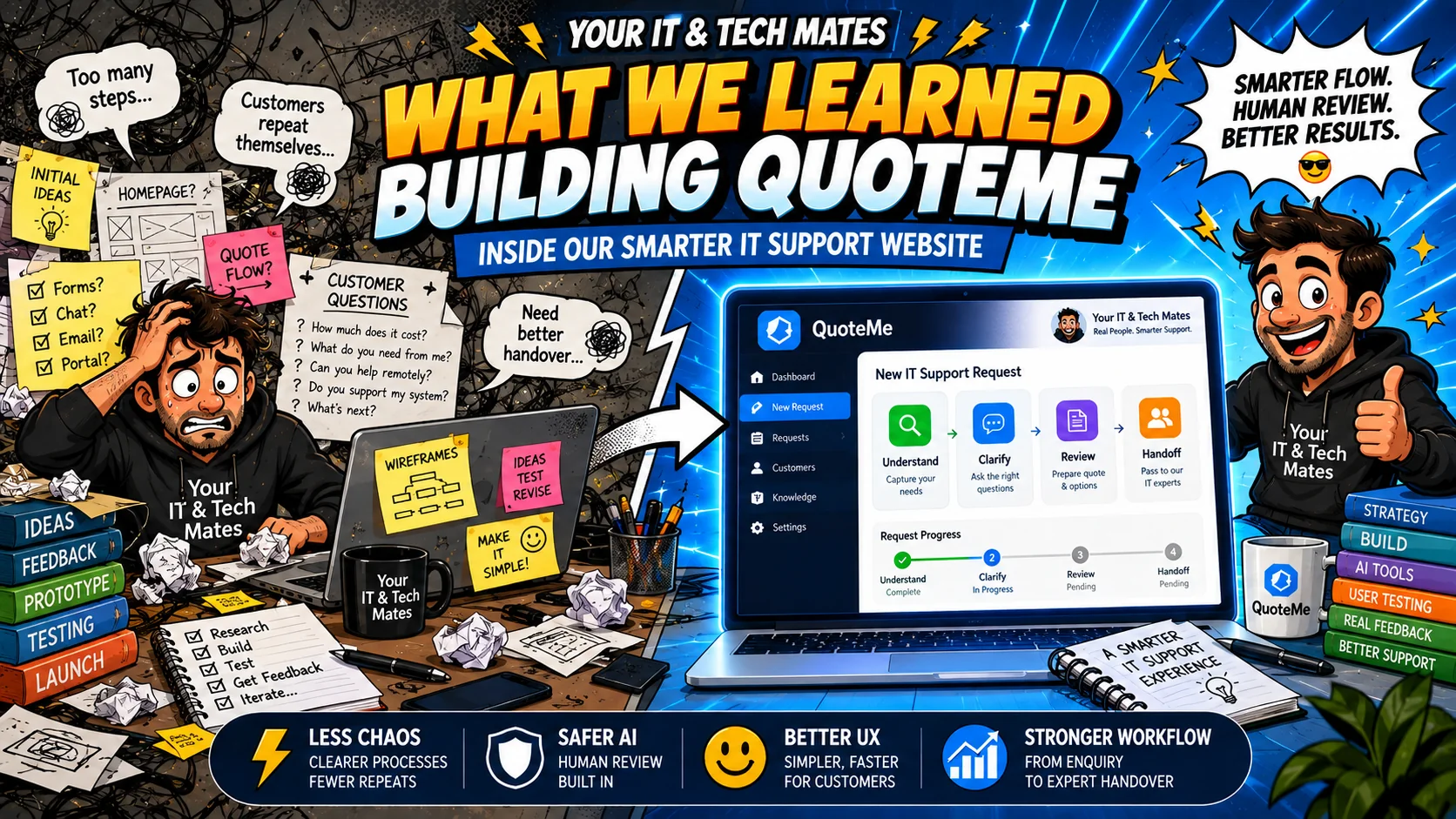
Building QuoteMe taught us that the best customer workflow is usually not one giant smart form. It is a sequence: understand the problem, clarify only what matters, return a useful result, preserve the customer’s wording, and hand off into the existing service process with human review.
Lesson 1: do not make customers translate their problem into your service catalogue
People describe outcomes and symptoms. Businesses organise work into service categories. Those are different languages. The website should do more of the translation instead of forcing customers to choose a technical label before they understand the problem.
Lesson 2: fewer questions can produce better context
Long forms feel thorough but often collect low-value information. The better approach is progressive clarification: ask one question when the answer changes the next step. If the customer already told us the important part, do not ask it again in a different field.
Lesson 3: keep the original customer wording
Structured fields are useful, but they should sit beside the customer’s own description rather than replace it. “Laptop died after an update and I need my accounting files” carries context that can disappear if the system stores only “device repair / startup fault”.
Lesson 4: safety rules should be deterministic and visible
For issues such as battery swelling, smoke, sparks, burning smells, liquid damage or data-risk scenarios, reviewed safety stops should take priority over clever conversational behaviour. Those rules need to remain understandable, testable and independent of a model improvising a response.
Lesson 5: AI should assist the journey, not own pricing or submission
We found it useful to keep pricing, routing, payment, submission and customer identity logic in the existing systems that already own those decisions. AI or guided tools can prepare context, but they should not become a second source of truth for commercial rules.
Lesson 6: the handoff is part of the product
A smart front end is wasted if the customer reaches QuoteMe and has to start again. Continuity matters: a useful summary, confirmed facts and open questions should follow the customer into the next step. At the same time, prior chat history does not need to be replayed or stored just to provide continuity.
Lesson 7: show uncertainty instead of hiding it
Customers can handle “we cannot tell yet” when the explanation is useful. In many repair situations, the honest answer is that a symptom narrows the path but does not identify the failed component. Making that uncertainty visible is safer than presenting a neat but unjustified diagnosis.
Lesson 8: test the seams, not only the happy path
The risky bugs usually live between systems: restored sessions, handoff tokens, old source context, duplicated prefilled text, safety exits and the point where a reviewed summary becomes a real request. Regression tests around those boundaries matter as much as the visual interface.
Where we are taking the idea next
Our current direction is to make high-intent guides more interactive, starting with situations such as a laptop that will not turn on. The guide should help first, then carry confirmed context into QuoteMe. The measure of success is not how much AI appears on screen; it is whether customers reach the right next step with less repetition and clearer expectations.
Frequently asked questions
Is QuoteMe a chatbot?
Not really. The wider experience uses guided and conversational elements, but QuoteMe is the reviewed request journey that carries useful customer context into the service process.
Why keep existing pricing and submission logic separate?
Those systems are already the authority for commercial rules. Keeping them separate reduces the risk of an AI layer inventing or overriding important business logic.
What was the biggest UX lesson?
Do not make the customer repeat themselves. Preserve their wording, ask only what changes the next step, and make the handoff feel like a continuation.
Related reading
Need tech help now?
Start with the problem in your own words. QuoteMe can carry useful context forward, and you can review the request before sending it.
Follow Building QuoteMe in Public
Continue through the ten-part founder series, from the customer’s first question to clearer conversations, controlled tools and human-reviewed requests.