Why AI Websites Should Measure Successful Customer Journeys, Not Just Conversions
Good website optimisation values successful self-service, clearer routing and lower customer effort, not only forms, calls and quote submissions.
Quick answer
A conversion is only one possible successful outcome. An AI-assisted website should also measure whether customers find a useful answer, reach the right service, avoid unnecessary questions and complete the journey with less confusion.
What we measure beyond the conversion
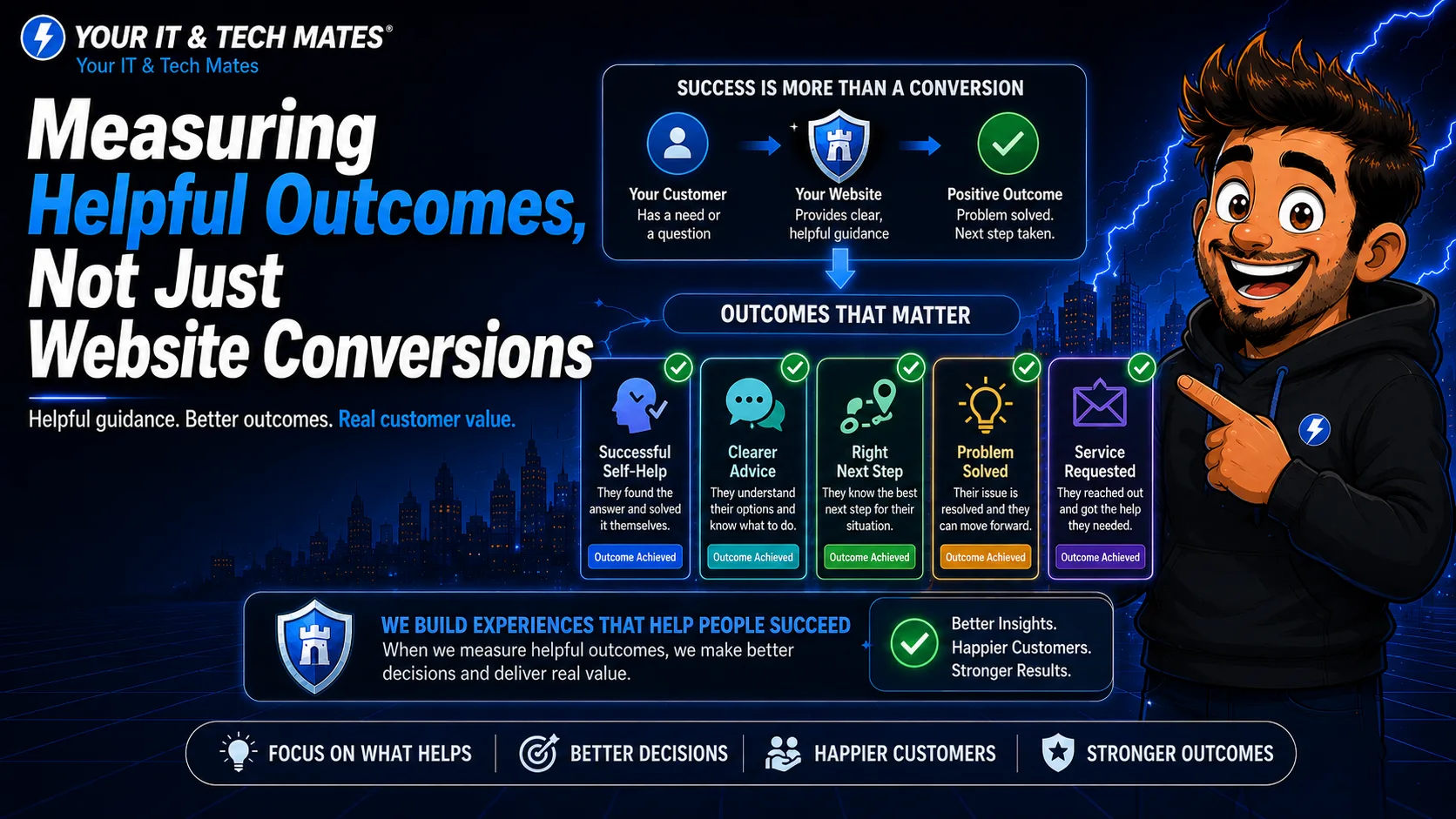
Our newer journey-quality work measures whether the website was genuinely helpful before assuming that a form submission was the only success. Readiness bands can be compared with later outcomes, article intent can be checked against what customers later confirm, and repeated friction patterns can be surfaced for review.
- Successful self-help: the customer found enough guidance to solve the problem without unnecessary contact.
- Correct next step: the customer reached the right guide, tool, service or human hand-off.
- Better matched request: a submitted request contains context that fits the service actually needed.
- Lower friction: fewer corrections, fewer unnecessary questions and fewer backtracks.
- Content that matches reality: articles can be reviewed when downstream customer intent repeatedly differs from the meaning declared by the publisher.
A conversion still matters, but it sits inside a wider definition of customer success. That makes optimisation less likely to reward pressure, confusion or unnecessary enquiries.
Why conversion-only optimisation can distort the experience
If the only goal is form submissions, the site is rewarded for pushing people toward forms even when a guide or tool would solve the problem better. That can increase low-quality enquiries and customer frustration.
Define a portfolio of successful outcomes
Useful outcomes can include self-service resolution, a completed check, correct service routing, a confident decision, a completed QuoteMe request or a hand-off to a human. Different intents may have different best outcomes.
Measure friction alongside success
A journey that converts after ten unnecessary questions may be worse than one that converts after two relevant questions. Track corrections, clarification count, repetition and time to the next useful step alongside completion.
Give self-service business value
Helpful self-service can reduce support load, build trust and qualify future enquiries. It can also show customers that the business is willing to help before asking for contact details.
Use outcomes to guide investment
When businesses know which journeys actually help, they can prioritise content, tools and service pathways based on evidence rather than traffic volume alone.
Practical example: success is sometimes not a sale
A scam-safety visitor who learns not to click a link and leaves the site has had a successful journey even though no quote was created. A customer who discovers that a simple restart solved the issue may also be successful. By contrast, a person who submits a quote for the wrong service after being confused is technically a conversion but a poor outcome.
Define outcomes by customer need: resolved with guidance, safely escalated, correctly quoted, appropriate pickup requested, useful call started, or intentionally redirected to another provider or official source. These outcomes are more informative than a single conversion rate.
Where it can go wrong: Do not optimise the journey to maximise form submissions. A trustworthy support site should sometimes help people avoid unnecessary work and should measure that as a positive result.
Related AI-assisted website guides
Continue with the guides that explain the underlying customer-experience, intent and governance ideas in more detail.
A successful journey does not always end in a sale
For a technology-help website, success can mean that a customer safely solved a simple problem, recognised a scam, found the correct service, understood that a repair needs diagnosis, or decided not to proceed because the information answered the question.
If analytics only rewards quote submissions, the website can be pushed toward unnecessary commercial prompts. That is especially risky in scam, cyber-safety, senior support and other protected journeys where the right outcome may be education or escalation rather than a sale.
Better outcome measures
- useful self-help completed;
- correct service or tool reached;
- customer correction resolved;
- safety guidance shown when needed;
- request submitted only after review;
- less repetition between the website and staff.
Conversion still matters, but it should sit inside a wider definition of customer success.
Frequently asked questions
Is a conversion always a successful customer journey?
Not necessarily. A conversion may be poorly matched, incomplete or created through unnecessary pressure.
What non-conversion outcomes should businesses track?
Useful self-service, correct routing, clarification recovery, completed tools and lower customer effort can all be meaningful.
Can measuring self-service reduce leads?
It may reduce unnecessary enquiries while improving trust and the quality of enquiries that do proceed.
How should businesses balance outcomes?
Use several measures together so the website is not optimised toward one metric at the expense of customer usefulness.
Could your website make customer journeys easier?
Tell us where customers get stuck, repeat themselves, choose the wrong path or submit poorly matched enquiries. We can review whether clearer content, website logic, automation, custom software or bounded AI fits the problem.
New: Intent-Aware Website business series
These newer guides show how content semantics, customer corrections, journey context and readiness signals can work together without turning ordinary browsing into certainty.