
Stop
Do not wait until the last minute if the issue affects study, campus work, proof of experience or a device you need for class.
On-campus help can include peer support, admin, event help, customer support, referrals, digital confidence, practical tech and Team Up projects.
Student experience pathway
TheFixers.APP pathway is designed for students who need practical experience before they already have a long work history. A student can start with small, safe tasks, build confidence, collect reviewed proof, and turn that activity into a clearer Live Resume story.
This guide is organised for quick decisions, safer checks and clearer next steps.
On-campus help can include peer support, admin, event help, customer support, referrals, digital confidence, practical tech and Team Up projects.
Use the guide to choose the right next step and avoid spending time or money in the wrong place.
Keep the model, symptom, photos, error messages and timing together before asking for help.
Use this guide first, then choose Quick Help or the most relevant local service page.
Do not wait until the last minute if the issue affects study, campus work, proof of experience or a device you need for class.
Read the practical steps, gather the details you already have and choose the pathway that best matches your situation.
Use the linked pathway or Quick Help if you need a real person to point you to the next step.
Choose the step that solves the real problem first, then avoid adding extra tools, bookings or work until the next action is clear.
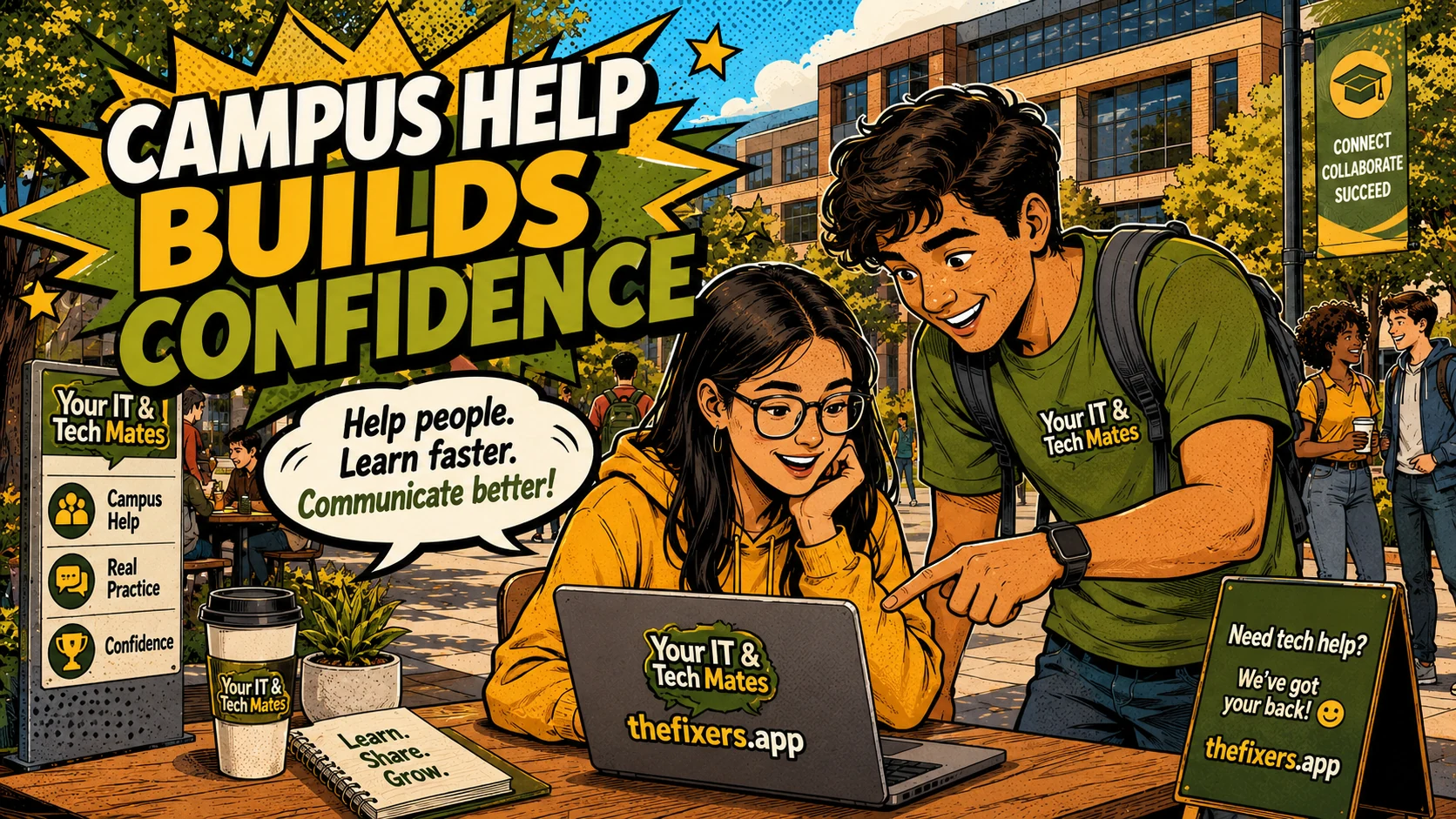
These examples show the difference between reading about a feature and seeing how it can help a student build confidence, communication and future job proof.
Students help with check-in, directions, QR codes, basic troubleshooting and follow-up notes.
A student helps another student understand a campus process, support request or simple digital tool.
A campus group organises help through clearer roles rather than scattered messages, so students know what is expected.
The student pathway should not sound like tech help only. Many students can help on campus through communication, organisation, referrals, admin, customer support, event support and Team Up projects. These are practical ways to build employability before formal work experience.
Students get the most value when each task is clear, safe and connected to learning. A small task can become useful proof when the student understands the role, records the outcome and reflects on what skill it shows.
A student might start with one small task, such as helping at a campus desk, following up a referral, supporting a simple tech question, helping with an event, or joining a small Team Up project. The important part is not that the task is big. The important part is that the student can explain the situation, the role they played, the result, and what skill it shows.
For example, a non-technical student could help promote a campus support offer, answer basic questions, record enquiries, and send a follow-up message. That can show communication, admin, marketing and customer support skills. A practical student could help with a simple device or software task, stay inside boundaries, ask for guidance when needed, and turn the outcome into a skill tag or live-resume note.
This is the difference between a thin resume claim and useful proof. A thin claim says, “I am organised.” A stronger student example says, “I helped coordinate a small campus support task, checked who needed help, kept notes, followed up with people, and learned how to communicate clearly when the task changed.”
Campus help can include explaining, organising, sharing, following up, supporting events, helping clubs and coordinating small tasks. This gives non-technical students a real place in the pathway while still supporting practical tech help where suitable.
Students practise communication, organisation, admin notes, customer updates, task scoping, follow-up and guidance requests.
Instead of saying they are reliable or good with people, students can explain what happened, what they did, what feedback they received and what they learned.
Choose a guide based on the next question you have. Each page connects practical activity with safety, guidance and live-resume proof.
How campus help jobs can build my confidence, communication skills, tech support experience and real-world proof through safe local help.
Open guide → GuideCampus help requests can become useful skill proof when a student completes suitable real work, receives feedback, records the outcome and connects it to skill tags or a live resume.
Open guide → GuideThe Campus Master idea gives experienced students a safer way to lead, guide and review newer students instead of leaving less experienced helpers to guess on their own.
Open guide → GuideA Campus Partner Portal can give schools, TAFEs, universities and student groups a reviewed pathway for student requests, Campus Masters, safety terms and clear support scope.
Open guide → GuideA customer portal can help students keep requests, updates, next steps and proof clearer instead of relying on scattered messages.
Open guide → GuideStudents can help classmates safely when requests are clear, boundaries are visible, guidance is available and work avoids private data, assessed academic work and unsafe promises.
Open guide → GuideOn-campus help becomes stronger live resume proof when students can show what they helped with, how they communicated, what they learned and how the work was reviewed.
Open guide → Guidethefixers.app can support on-campus student help beyond device fixes: peer support, study admin help, orientation tasks, campus questions, simple setup help and reviewed student-to-student assistance.
Open guide → GuideSchools, TAFEs and universities can support student helpers by keeping requests appropriate, using guidance, recognising skills and making campus help visible but safe.
Open guide →Choose the pathway that fits you: campus help, support, referrals, Team Up, leadership or practical tech help.
Skill tagsLearn how real activity can turn into skill tags and proof students can explain.
EmployabilityExplore how student work can build organisation, project management and people-management evidence.
Start from the student join page, or return to the full gateway to compare help, campus, referral, Team Up and leadership pathways.
Keep building proof
Students can now follow a plain-English guide branch that connects campus missions, Volunteer tags, soft skills, job-family proof, resume showcase cards and paid review readiness.
Read the new campus helper branch for real student examples, Volunteer-tagged resume proof, interview wording, Melbourne North campus context and simple next steps.
A0010720 student blog polish: written for students who want clear proof for future jobs, not confusing career jargon.