Intent-Driven Website Examples for Small Businesses
See how electricians, plumbers, handyman services, restaurants and other businesses can guide customers from ordinary wording to a relevant next step while people retain control.
Quick answer
An intent-driven website adapts the next step to what the customer is trying to achieve. An electrician may need safety-first triage, a plumber may need an urgent leak pathway, a handyman may need several tasks grouped into one enquiry, and a restaurant may need staff confirmation for an allergy question. The website helps organise the journey; it does not replace the qualified person, business process or customer decision.
These are practical scenarios, not claimed case studies
The examples below show how an intent-driven pattern could work for different businesses. They do not claim that these businesses implemented the system or achieved a measured result.
A genuine case study should identify a real approved implementation, what changed, the evidence available and any limitations. Keeping that distinction clear prevents an illustrative idea from being presented as proof.
The pattern that stays consistent
- The customer describes the goal or problem.
- The website matches it to reviewed business knowledge.
- Relevant information and approved options appear.
- The customer chooses whether to continue.
- A responsible person confirms consequential decisions.
The wording, safety rules and actions change for each industry. The control pattern does not.
Electrician website example
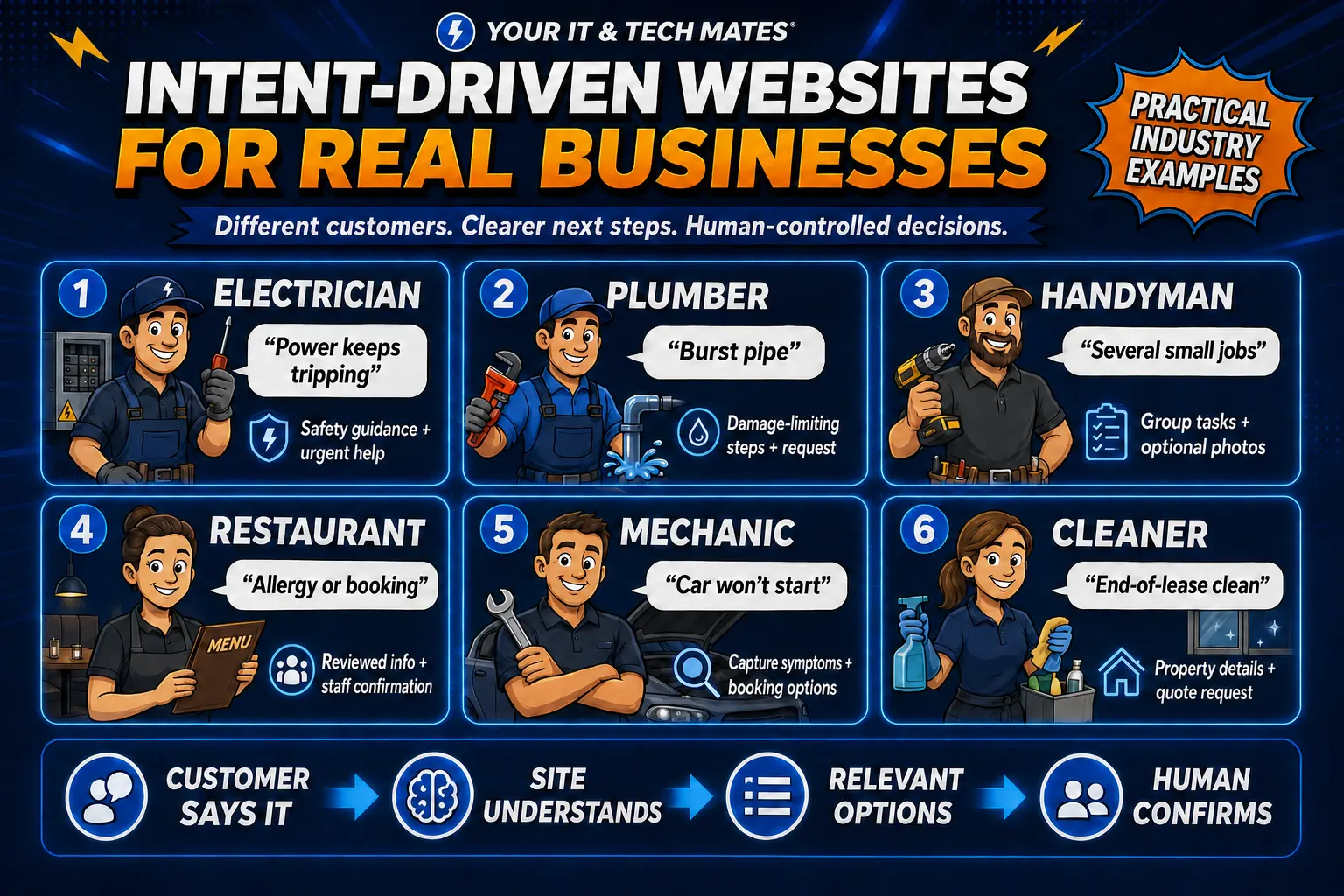
Customer says: “The power keeps tripping and there was a burning smell.”
Website understands: This may be an electrical-safety situation, not a routine pricing enquiry.
Relevant next step: Present approved immediate safety guidance, make emergency escalation prominent and collect only the information appropriate for a deliberate service request.
Human confirmation: A qualified electrician confirms urgency, attendance, diagnosis, scope and price. The website must not tell someone to interact with unsafe electrical equipment or wait online when emergency help is required.
Benefit: Safety information appears before generic service menus and the customer is less likely to choose an irrelevant form.
Plumber website example
Customer says: “A pipe has burst under the sink and water is spreading.”
Website understands: The immediate goal is to reduce damage and request urgent plumbing help.
Relevant next step: Show reviewed damage-limiting guidance where safe, ask about location and affected area, and offer the approved urgent-request path.
Human confirmation: The plumber confirms availability, safe next actions, likely scope and price. Opening the page does not guarantee attendance or create a booking.
Benefit: The customer sees the urgent pathway instead of browsing hot-water, renovation and general-maintenance pages.
Handyman service website example
Customer says: “I need shelves installed, a hole patched and a door adjusted before I move out.”
Website understands: This is one multi-task handyman enquiry rather than three unrelated service forms.
Relevant next step: Group the task list, ask for the suburb and timing, and allow optional photos that help the customer explain the work.
Human confirmation: The handyman reviews whether each task is within scope, identifies materials or specialist trades required, and confirms availability and price.
Benefit: The customer explains the job once, while the business receives a clearer task summary for review.
Restaurant or café website example
Customer says: “Can you accommodate a nut allergy for a birthday dinner?”
Website understands: This is both an allergy-information question and a group-booking enquiry.
Relevant next step: Present approved allergy and booking information, collect the preferred date and party size, and make staff confirmation explicit.
Human confirmation: Restaurant staff confirm current ingredients, preparation limitations, cross-contact risk, availability and the booking. The website must not make an automatic safety guarantee.
Benefit: Important safety context reaches the right person instead of being buried inside a generic reservation note.
Mechanic website example
Customer says: “My car will not start, but the lights still come on.”
Website understands: The customer needs vehicle-help options and may be stranded, but the symptom is not a confirmed diagnosis.
Relevant next step: Ask for vehicle details, location and a few reviewed symptoms, then show suitable towing, inspection or booking options.
Human confirmation: A mechanic or roadside professional confirms the safe response, diagnosis, parts, availability and price.
Benefit: Staff receive useful context without the website pretending that one symptom proves a battery, starter or electrical fault.
Cleaning business website example
Customer says: “I need an end-of-lease clean next Friday.”
Website understands: This is a date-sensitive service with property details and possible extras.
Relevant next step: Ask for property type, bedrooms, bathrooms, timing and optional extras, then prepare a reviewable quote request.
Human confirmation: The cleaning business confirms availability, inclusions, exclusions, property condition and fixed price.
Benefit: Customers see the relevant questions immediately instead of using a one-size-fits-all contact form.
Landscaper or gardener website example
Customer says: “The garden is overgrown and I want it ready before an inspection.”
Website understands: The customer has a deadline and may need cleanup, mowing, pruning or waste removal.
Relevant next step: Ask about the property, timing and main tasks, allow useful photos, and show the appropriate assessment or quotation path.
Human confirmation: The business confirms access, equipment, green-waste arrangements, scope, timing and price.
Benefit: Several related needs become one understandable job brief.
Accountant or bookkeeper website example
Customer says: “I received an ATO letter and I am not sure what I need to do.”
Website understands: The customer may have a deadline and needs the appropriate professional review, not generic marketing content.
Relevant next step: Explain what documents may help, make deadlines visible without interpreting the notice as professional advice, and offer the correct consultation path.
Human confirmation: A qualified professional reviews the actual document, confirms obligations, advice, scope and fees.
Benefit: The customer reaches the right service with better preparation while important advice stays accountable.
Property manager or real-estate website example
Customer says: “There is water coming through the ceiling in my rental.”
Website understands: This may be urgent property maintenance rather than a general tenancy question.
Relevant next step: Show the approved emergency-maintenance instructions, collect the property and issue details, and route the deliberate report to the established maintenance process.
Human confirmation: The responsible property team or emergency service confirms action, authority, contractor attendance and costs.
Benefit: Urgent maintenance is separated from routine enquiries without treating a browser message as verified tenancy or automatic work approval.
IT support provider website example
Customer says: “Our business email has stopped and five staff are affected.”
Website understands: This is a business-impacting email issue that may involve an existing customer or a new support request.
Relevant next step: Separate verified existing support from new enquiries, show safe checks, capture affected users and timing, and carry the summary into the approved request path if the customer chooses.
Human confirmation: A technician confirms identity, access, diagnosis, scope, security actions and price. Public wording never unlocks private records or authorises a system change.
Benefit: The issue reaches the right workflow with less repetition and clearer security boundaries.
What these businesses gain from the same pattern
- Customers can start with the situation they understand.
- Safety or urgency can take precedence over generic sales content.
- Several related details can become one reviewable summary.
- Irrelevant choices can be reduced without hiding normal navigation.
- Existing-customer and new-enquiry paths can remain separate.
- Human confirmation remains visible wherever scope, safety, availability or price matters.
How to choose the first journey for your business
Do not begin by trying to make the whole website “intelligent”. Choose one journey where customers repeatedly hesitate, select the wrong option or re-enter the same information.
Map the customer’s ordinary wording, the approved information, the safe outcomes and the person responsible for the final decision. Improve the content and forms first. Add predefined rules or bounded AI only where they make that reviewed journey clearer.
Frequently asked questions
Are these real case studies?
No. They are practical industry scenarios showing how the pattern could be applied. A case study should describe a real approved implementation and verified evidence.
Does every business need a different intent engine?
No. The shared pattern is customer wording, reviewed interpretation, relevant options and human confirmation. Each business configures its own approved knowledge, safety boundaries and actions.
Does an intent-driven website need AI?
Not always. Clear choices and predefined rules can handle many common situations. Bounded AI can help interpret varied everyday wording when it adds genuine value.
Can the website automatically book or quote the work?
Only where the business has an approved transaction process and the customer explicitly chooses it. These examples keep availability, scope, fixed price and consequential decisions under the normal accountable process.
Which customer journey should be improved first?
Start with one journey where customers regularly choose the wrong option, repeat information or need the same clarification from staff.
Which customer journey causes the most friction?
Tell us where customers get stuck, repeat information or choose the wrong path. We can review the workflow before recommending clearer content, forms, automation, custom software or bounded AI.