What Is Journey Outcome Intelligence? How Smarter Websites Learn Which Paths Actually Help Customers
Look beyond page views to understand which sequences of pages, tools, questions and next steps are associated with useful customer outcomes.
Quick answer
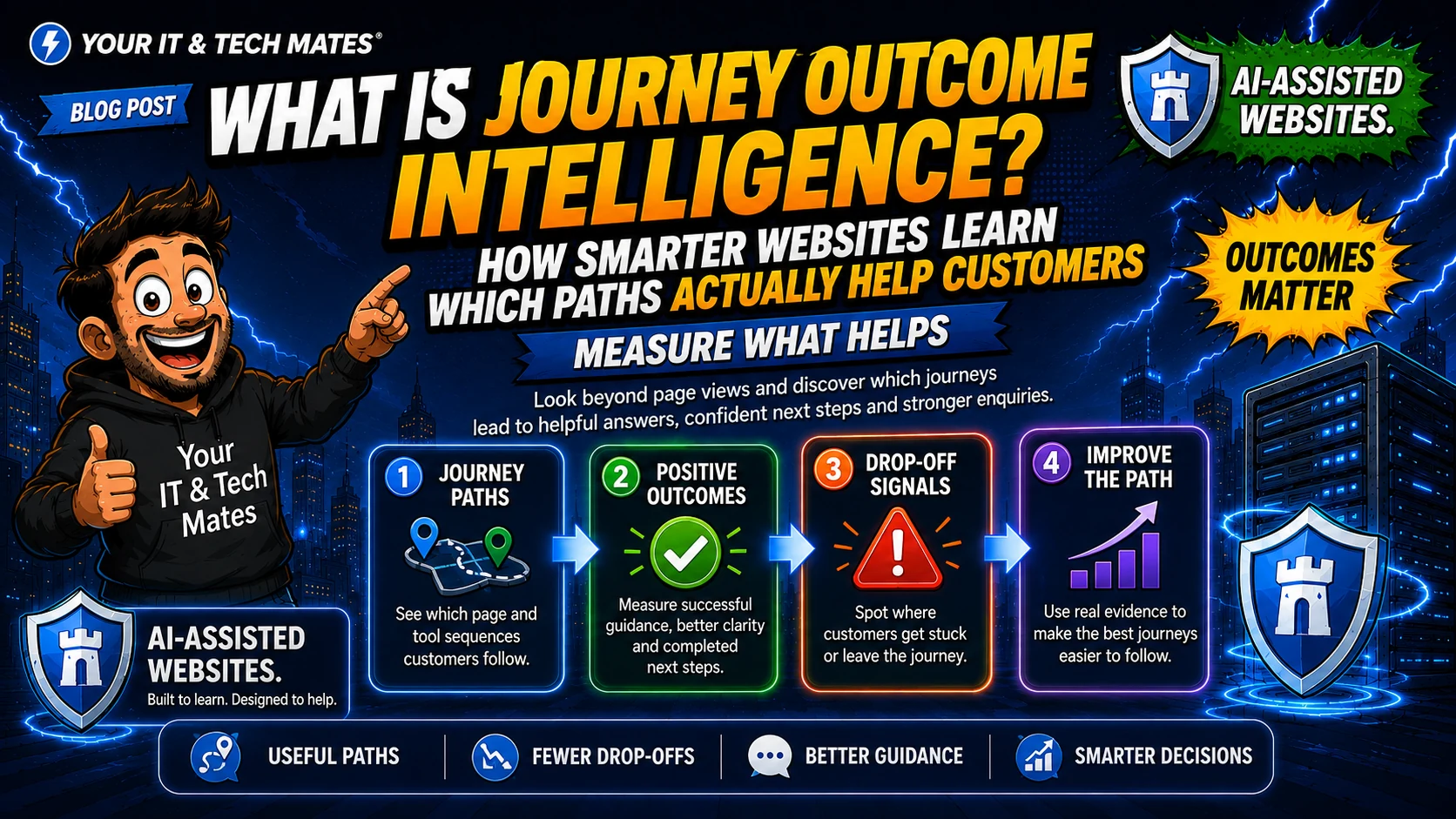
Journey outcome intelligence means evaluating website journeys by what happens after people move through them, not simply counting visits. It connects privacy-minimised journey patterns with outcomes such as successful self-service, correct routing, clarification recovery and completed enquiries.
Why page views are not enough
Two visitors can view the same three pages and have very different experiences. One may reach the right answer quickly; another may loop because the navigation is unclear. Journey outcome analysis adds context to traffic data by asking which paths are associated with useful results.
What counts as a positive outcome
A positive outcome can include a completed diagnostic, a confirmed help area, a useful self-service answer, a successful clarification, a correctly routed service path or a completed request. The right definition depends on the customer goal, not just what produces a conversion event.
Treat abandonment carefully
A visitor closing a browser is not reliable proof of failure. They may have found what they needed. Stronger systems distinguish explicit abandonment or correction signals from simple inactivity, and avoid claiming causation when the evidence only shows association.
Use transition quality to improve navigation
When enough observations exist, businesses can compare transitions such as service → tool, tool → guide or tool → quote. A transition with strong outcomes can be made more prominent; one associated with confusion can be rewritten, relocated or tested with a better alternative.
Why this matters commercially
Journey outcome intelligence helps businesses invest in the parts of the website that reduce customer effort and improve qualified enquiries. It can also show when a self-service path is doing valuable work even if it does not generate a form submission.
Practical example: connect a recommendation to what happened next
Suppose the Intent Engine recommends pickup for a cracked-screen enquiry. The useful learning signal is not simply that the customer clicked Pickup; it is whether the request was eligible, completed and ultimately matched the repair need. That outcome can tell staff whether the recommendation was useful without requiring a behavioural profile of the person.
Outcome intelligence should use a small set of business-defined states and join them only where there is a legitimate operational relationship, such as a submitted request reference. Anonymous browsing should remain anonymous unless the customer chooses to submit information.
Where it can go wrong: Be careful with incomplete outcomes. A customer who does not submit today may call tomorrow, solve the problem themselves or decide not to proceed. Treat unknown outcomes as unknown rather than negative.
Related AI-assisted website guides
Continue with the guides that explain the underlying customer-experience, intent and governance ideas in more detail.
Frequently asked questions
What is journey outcome intelligence?
It is the practice of connecting privacy-minimised website journey patterns with later useful outcomes so businesses can understand which paths appear to help customers.
Is it the same as conversion tracking?
No. Conversion tracking usually focuses on a goal event. Journey outcome analysis can include self-service, correct routing, clarification recovery and other useful outcomes.
Does a visitor leaving always count as abandonment?
No. Inactivity alone is ambiguous. Stronger analysis uses explicit or governed signals rather than assuming every exit is failure.
Can journey outcomes improve navigation?
Yes. Repeated transition patterns can reveal which routes are useful and where visitors may need clearer next steps.
Could your website make customer journeys easier?
Tell us where customers get stuck, repeat themselves, choose the wrong path or submit poorly matched enquiries. We can review whether clearer content, website logic, automation, custom software or bounded AI fits the problem.