What you need to know
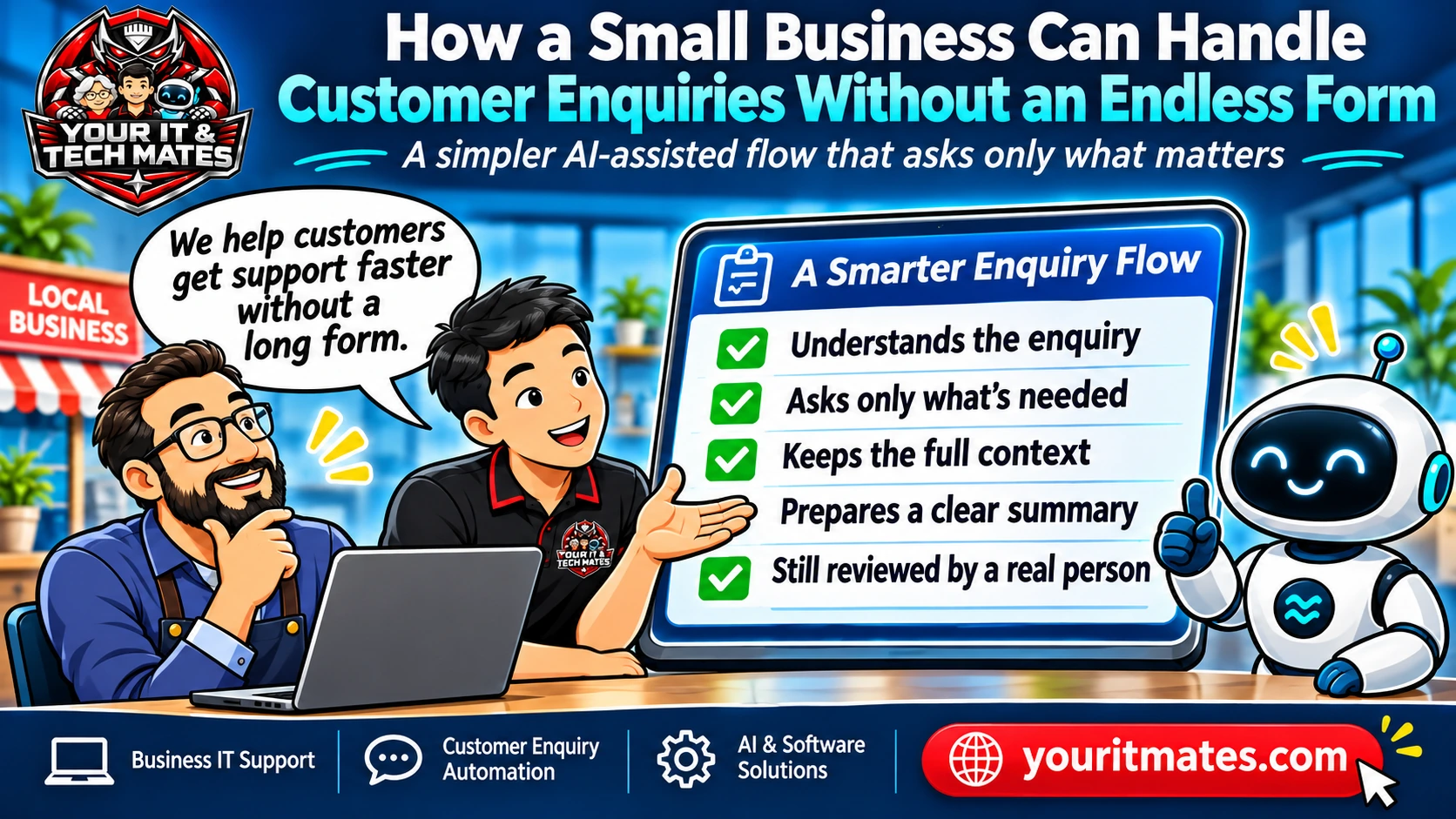
A shorter enquiry is only better when staff receive accurate details. Let customers explain their goal, reuse facts they already supplied and ask targeted questions before presenting an editable summary. AI may help interpret language; people still approve quotes and decisions.
Three useful things to note
- Start with one ordinary-language problem or question field.
- Ask only for details that change the next staff action.
- Let customers review corrections, contact details and consent before sending.
Why long forms create extra work
A customer might say 'I need a quote' without knowing the service category, urgency or technical details. A rigid form asks them to choose options they do not understand and can make a simple request feel like an exam. A chatbot that asks the same questions again is not an improvement.
The business also pays the price. Staff receive vague descriptions, missing contact details or notes copied between systems. The challenge is not simply automating replies; it is collecting accurate information once and making the next step understandable.
Begin with the customer's actual goal
An effective opening invites a plain-English question or problem. The system first distinguishes whether the customer needs an answer, help with a fault, a service enquiry, a complaint or another route. It should not funnel every message into sales.
Known facts should be carried forward with clear provenance. 'My laptop is slow and the Wi-Fi drops' describes two concerns, not an excuse for the software to assume that the router is broken. When intent is unclear, a short targeted clarification is safer than a confident guess.
Ask fewer, better questions
Question selection should reflect what has already been said. Ask for the make or model only when it meaningfully affects the next step, and allow 'not sure'. Collect contact details in a compact, accessible step rather than interrupting diagnosis with repeated identity prompts.
The system also needs an obvious edit control. A customer who changes 'Dell' to 'Lenovo' should be able to correct the summary without restarting. Multiple issues should remain visible and a question about pickup or coverage must not trap an unfinished service request.
Keep AI within approved boundaries
YITM's design approach combines structured routing, allowed question sets and bounded AI assistance for ambiguous wording. AI should not invent diagnoses, final repair prices, bookings, policy exceptions or customer consent. A clear fallback to staff is essential.
Personal information requires deliberate handling: collect only what is needed, avoid exposing secrets in logs or prompts, and distinguish observed customer wording from inferred categorisation. Improvements suggested by conversation analysis should be reviewed before changing production behaviour.
Hand over an accurate case, not a transcript dump
Staff benefit from a concise summary showing the customer's stated problem, answered clarifications, uncertainties, service preferences and contact route. An original description can be retained where justified so a technician can compare the summary against what was actually said.
The customer should review that information before submitting. Confirmation that an enquiry was received is different from accepting a priced quote or booking a visit. Each state needs a separate and accurate explanation.
How a small business should measure success
Track where customers abandon the flow, the number of questions, how often known facts are repeated, incomplete submissions and staff clarification requests. Review these measures without assuming that fewer questions always means a better outcome; safety-critical information still matters.
YITM is using its own service journey as a practical design and testing environment. This article explains an approach and its trade-offs; it does not claim measured conversion lifts, autonomous learning or guaranteed performance results.
A practical starting point for other operators
Before buying a chatbot platform, map one common enquiry from first message through human follow-up. Write down what staff truly need to act, which customer questions recur and where information is lost. Then prototype a short flow using existing website and business systems.
Run ordinary and messy scenarios—including corrections, urgent requests and people who do not know the service name—and insist on a manual fallback. A modest, auditable workflow often serves customers better than a complex automation that no one can explain.
Frequently asked questions
Will AI replace the person preparing a quote?
It should not by default. AI can help collect and organise information, while staff retain authority over assessments and binding offers.
Does a shorter form always convert better?
Not necessarily. Test completion quality, customer understanding and safety as well as action counts.
Can existing websites use this approach?
Often the first step is adapting the enquiry and handover process, not replacing the whole website.
How can a business avoid repeated questions?
Keep an explicit, consent-aware case record and check known facts before selecting the next question.
Need help with your own situation?
Tell us which customer workflow is causing unnecessary work. We can discuss practical options, integration boundaries and human review before any proposed software work is scoped.
Discuss your business workflow Explore more software and ai for business articles