How We Built Cross-Page Journey Context Without Making Customers Repeat Themselves
One short-lived journey context helps the website keep its place while authenticated customer records stay in their existing verified systems.
Quick answer
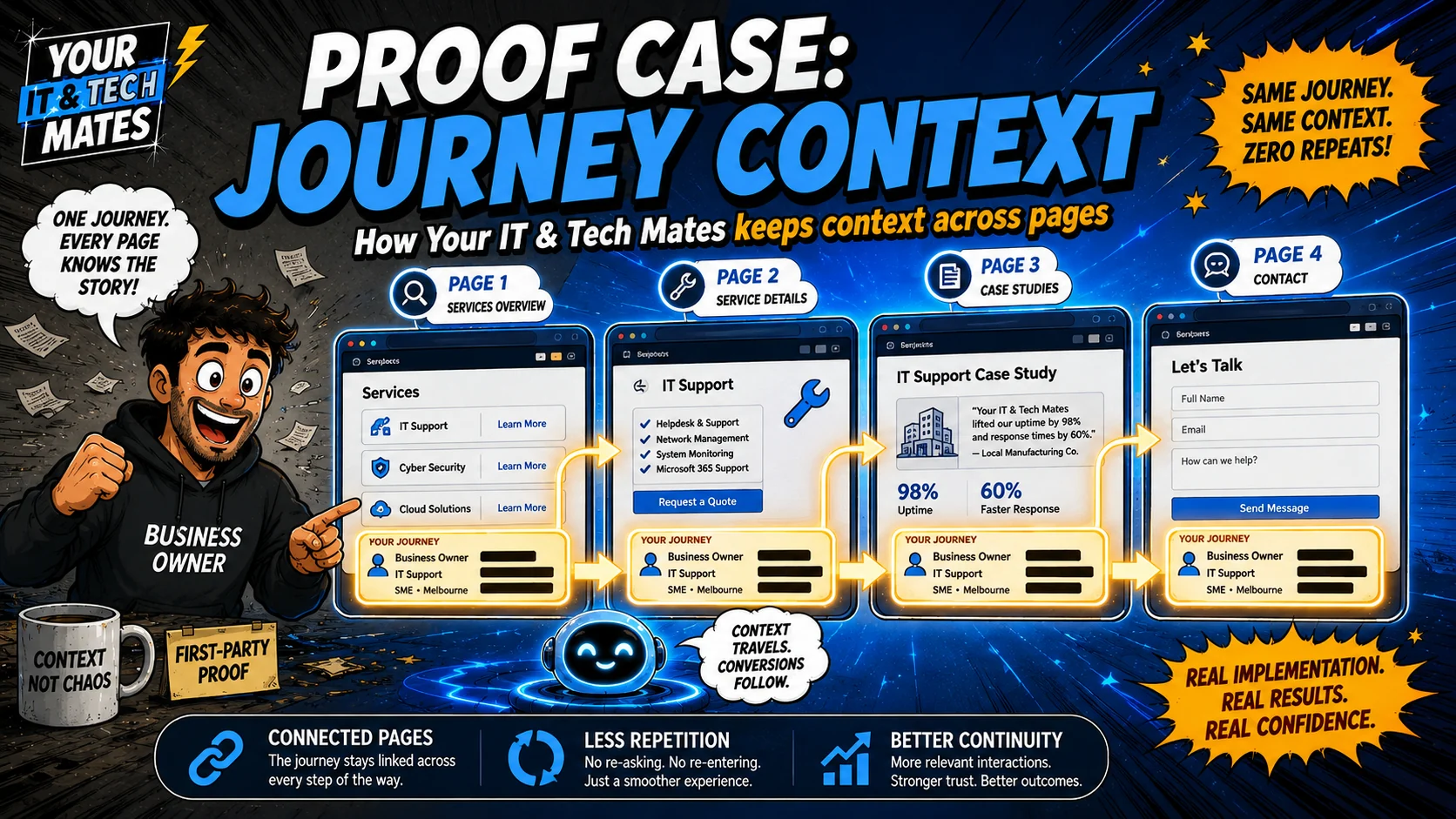
We added a redacted, session-scoped journey context across supported public website surfaces. It carries structured journey state between homepage, service pages, Smart Enquiry and QuoteMe, expires under the session time limit and does not create a request or paid work automatically.
The practical problem
A website can look intelligent on one screen yet still make a customer restart when they move to the next page, form or staff handover. We wanted the intelligence to continue across the journey without creating a second request system or giving automation authority it should not have.
What we built
A shared journey-context layer that keeps the resolved need, risk state and workflow context available across supported public pages while keeping the reusable across different organisations and the current production experience specific to Your IT and Tech Mates.
How the workflow works
- Customer describes the need on a supported public surface.
- The existing intent and journey engines resolve structured journey state.
- Only approved, redacted context is written into the short-lived session journey.
- A later service page or Smart Enquiry can read the same context and present a coherent next step.
- When the customer deliberately opens QuoteMe, the existing request workflow can inherit the controlled journey context for review.
Evidence we can show
The architecture explicitly separates cross-page context from customer identity and authenticated request ownership. The context is session-only, redacted and expiry-bound; opening pages does not create a booking or request.
Human and safety boundaries
The journey may interpret, organise, recommend and prepare. It does not silently submit QuoteMe, authenticate a customer, approve final pricing, authorise payment or approve paid work. High-risk states continue to override ordinary commercial routing.
What this does not prove
This proof does not claim that browser context authenticates a customer, replaces private request records or preserves unlimited conversation history. Hosted deployment still needs normal final live-site testing.
Frequently asked questions
Does this create a second customer or request system?
No. The journey layer coordinates existing owners. QuoteMe remains the structured new-request owner and verified customer systems remain responsible for existing requests.
Can the system automatically approve a quote or paid work?
No. Final scope, diagnosis, pricing and paid work remain under the existing human-controlled process.
Is raw customer conversation stored in journey analytics?
No. Journey analytics uses structured outcome events rather than raw enquiry wording.
What happens when the system is unsure?
Clarification or staff review takes precedence over pretending to have a confident answer.
Related Your IT and Tech Mates guidance
Could a similar customer journey help your business?
Tell us where customers repeat themselves, choose the wrong path or get stuck between your website and your real workflow. We can review whether better software, automation, AI—or a simpler process change—would help. A person confirms scope and pricing before paid work starts.
Connect this guide to the wider Software & AI library
This topic is part of a wider customer-journey system. Use these related guides and first-party implementation examples for the next layer of detail.