How Staff Decide Which Customer Questions Need Better Website Content
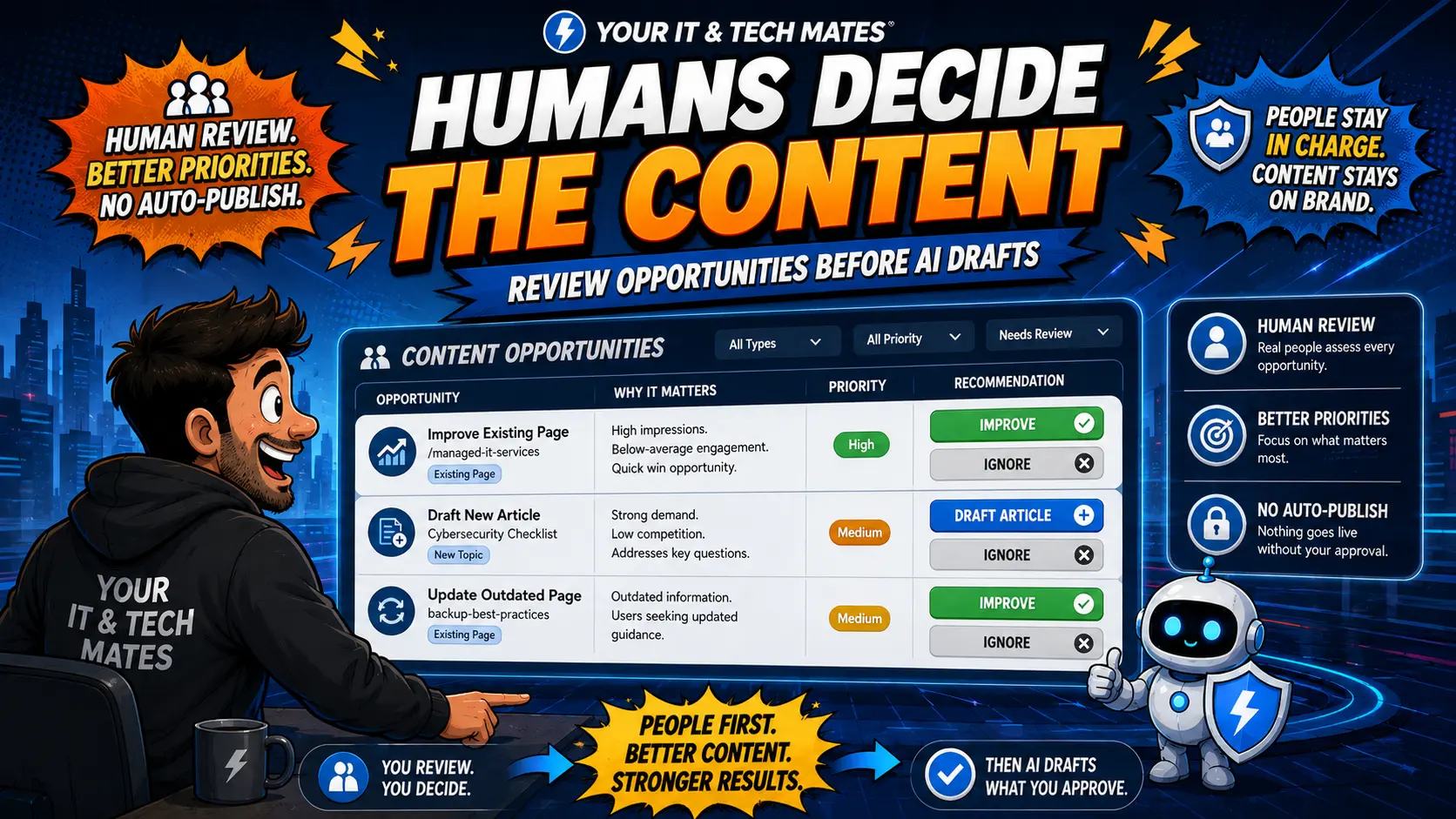
A private dashboard shows repeated gaps in customer help. Staff decide whether to improve an existing page, draft something new, ignore the signal or check it again later.
Quick answer
A private dashboard shows repeated gaps in customer help. Staff decide whether to improve an existing page, draft something new, ignore the signal or check it again later.
The practical problem
Finding a repeated customer-help gap does not mean the business should automatically create another article. Doing that could produce duplicate pages, confusing search results or claims nobody has checked.
What we built
We built a staff-only review screen that shows broad demand and the closest existing content. A person decides whether the real fix is improving an existing page, preparing a new draft, taking no action or checking again later.
How the workflow works
- A repeated customer-help gap becomes ready for staff review.
- Staff see the topic, broad demand and the closest existing information.
- A person chooses Improve Existing, Draft New, Ignore or Recheck.
- Only an approved Draft New choice can move into the normal drafting process.
- Drafting and publishing still have their own separate reviews and controls.
Where AI is useful
AI can help with a draft after staff approve the topic, but AI is not needed to decide whether a new page should exist.
Where AI is not allowed to decide
The dashboard cannot publish, create services, set prices or treat customer demand as proof that an unsupported claim is true.
Security, privacy and cost controls
The dashboard is staff-only and uses broad totals rather than showing raw customer searches. A published topic only returns for review when later demand grows enough to justify another look.
What another small business can take from this
Separate “customers keep asking about this” from “we should publish a new page”. That gives staff time to choose the simplest and safest fix.
What this does not prove
Choosing to create a draft does not mean the draft will be published. It still has to pass the normal checks for duplicates, links, claims, reviewer ownership and page quality.
Part of our smarter website project
This implementation story is one part of a larger Your IT and Tech Mates project exploring how practical AI, automation, trusted business knowledge and human-controlled workflows can work together.
Frequently asked questions
Does every repeated question create a new article?
No. Staff decide whether to improve an existing page, draft something new, ignore it or review it later.
Can AI make that decision?
No. The content opportunity decision belongs to authorised staff.
Does the dashboard show raw customer searches?
No. It is designed around privacy-safe demand signals rather than exact customer wording.
Can a Draft New decision publish immediately?
No. It only starts the normal private drafting process; publication is a separate human-approved step.
Why might staff improve an existing page instead?
Often clearer wording, navigation or a better tool solves the problem without adding another public page.
Related Your IT and Tech Mates help
Could a similar workflow help your business?
Tell us how the process works today. We can look at whether better website logic, automation, custom software, AI—or something simpler—would be useful. A person reviews the request before any scope or price is agreed.