How Our Website Learns What Customers Need Without Saving Their Private Searches
We can notice repeated gaps in what customers are trying to find without saving the exact searches or turning them into public customer profiles.
Quick answer
We can notice repeated gaps in what customers are trying to find without saving the exact searches or turning them into public customer profiles.
The practical problem
A website can learn from repeated customer needs without keeping a permanent record of everything people type. The useful part is the pattern, not the unnecessary personal detail.
What we built
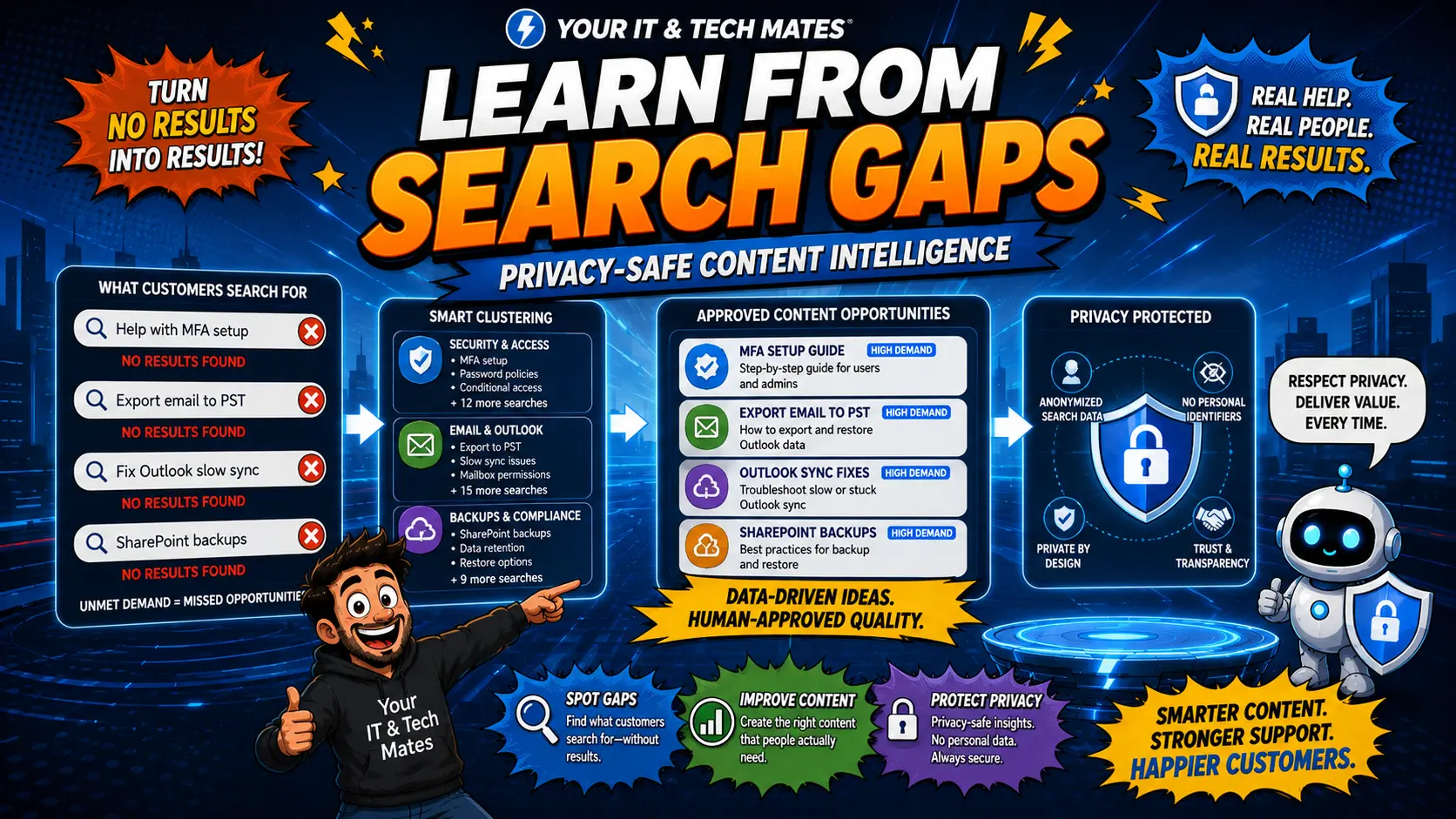
When the website cannot provide a strong answer, it records a limited anonymous signal about the type of gap. Repeated gaps can be shown to staff, but they do not automatically create content.
How the workflow works
- A customer asks for help and the website does not have a strong enough answer.
- A limited no-result signal is recorded.
- The system groups similar gaps and counts them without saving the exact wording for content generation.
- Repeated demand can become ready for staff review.
- Staff decide whether to improve a page, create a draft, change navigation or take another action.
Where AI is useful
AI is not required to record the gap. If staff later approve a new draft, AI can be used separately as an optional writing aid.
Where AI is not allowed to decide
This system cannot publish, invent a service, identify a customer or turn one unusual search into an automatic article.
Security, privacy and cost controls
Raw search wording is not copied into the public content-learning process. The private data kept for trend counting is limited and controlled.
What another small business can take from this
Ask what minimum information is really needed to see that customers repeatedly get stuck. Many businesses can spot useful patterns without keeping a detailed history of every search.
What this does not prove
Repeated demand does not prove that a new article is the answer. The better fix might be clearer navigation, a service-page change, a tool, a form improvement or direct human support.
Part of our smarter website project
This implementation story is one part of a larger Your IT and Tech Mates project exploring how practical AI, automation, trusted business knowledge and human-controlled workflows can work together.
Frequently asked questions
Do you save the exact words customers search for?
The content-learning process is designed to use limited grouped signals rather than copy raw search wording into public content data.
Does one failed search create a new article?
No. Repeated gaps only become a staff review signal.
Can the system identify a customer from the public learning data?
It is designed around aggregate patterns, not public customer profiles.
Is AI needed to record search gaps?
No. AI may be used later for drafting only if staff approve that separate step.
What else can fix a repeated search gap?
Clearer navigation, a better tool, a service-page rewrite, a form change or a human support path may be better than a new article.
Related Your IT and Tech Mates help
Could a similar workflow help your business?
Tell us how the process works today. We can look at whether better website logic, automation, custom software, AI—or something simpler—would be useful. A person reviews the request before any scope or price is agreed.