How Should Smart Enquiry Handle Multiple Problems and Changing Customer Needs?
Real customers change their story. A useful journey needs to update the active problems rather than freeze the first interpretation.
Quick answer
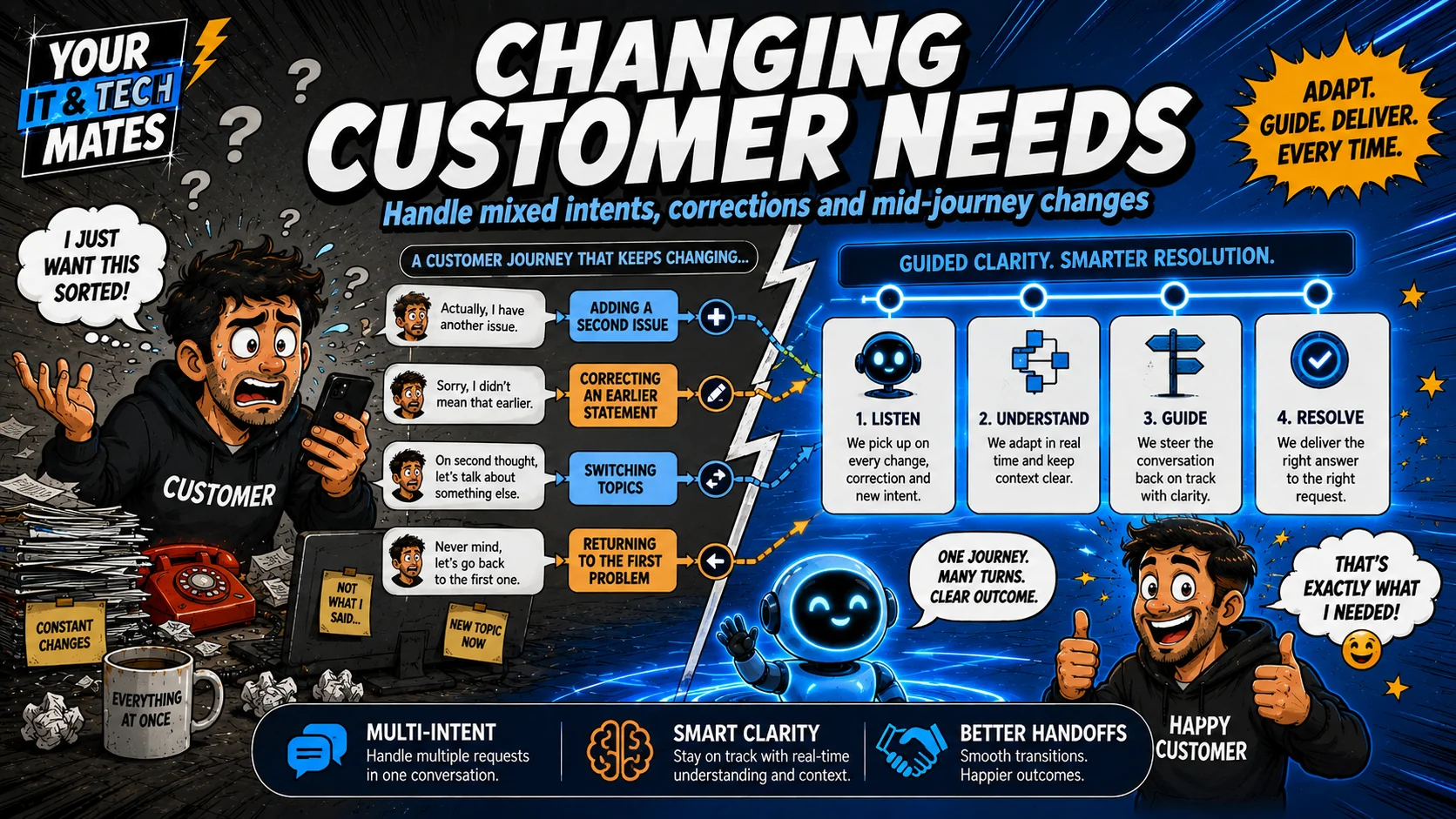
A multi-intent journey should maintain an active set of needs that can evolve. New problems can be added, stale ones can be retired, explicit corrections can replace the primary need and a previously removed problem can be reactivated if it comes back.
Why first-message classification is not enough
People often begin with one issue, remember another one later, say something is now fixed or correct an earlier assumption. If the system keeps only the first classification, the request bundle becomes stale.
Additive changes
When a customer says “also”, “and another thing” or otherwise clearly adds a need, the journey can keep the current main issue and add a bounded secondary requirement for the next workflow.
Retractions and corrections
Newer explicit wording should be able to retire old needs. Phrases such as “that part is fixed”, “skip that” or “I only need the other issue now” should not leave phantom work in the request.
Returning to an earlier problem
A later turn may return to something discussed several messages earlier. The journey needs chronological reconciliation so vague references and reactivated issues resolve against the latest relevant statements, not simply the last keyword.
One customer can have more than one real problem
Fixed forms often assume there is one category and one answer. Real support is messier. A customer might say, “My laptop is slow, the battery barely lasts and I also cannot connect to the office Wi-Fi.” A smart enquiry should not force all three symptoms into the first category it recognises.
A better workflow identifies a primary need, keeps secondary needs visible and asks only the question that changes the next step. The customer can then correct priorities before anything is submitted.
Useful handling pattern
- identify the most urgent or central problem;
- keep other credible needs as secondary context;
- separate safety issues from normal service questions;
- ask a clarification only when it changes routing;
- show the customer a summary they can edit before handoff.
This keeps the journey flexible without turning it into a long questionnaire.
Frequently asked questions
Can one enquiry contain more than one service need?
Yes. A controlled bundle can carry multiple active needs into the next workflow.
What if the customer says one issue is fixed?
The journey should retire that need rather than leaving it in the bundle.
Can a retired issue come back?
Yes. Explicit wording that the issue returned or should be added back can reactivate it.
Does the system store the whole conversation in analytics?
It does not need to. Ordered turns can be used as ephemeral analysis context while analytics stores only structured outcomes.
Related Your IT and Tech Mates guidance
Could a similar customer journey help your business?
Tell us where customers repeat themselves, choose the wrong path or get stuck between your website and your real workflow. We can review whether better software, automation, AI or a simpler process change, would help. A person confirms scope and pricing before paid work starts.
Connect this guide to the wider Software & AI library
This topic is part of a wider customer-journey system. Use these related guides and first-party implementation examples for the next layer of detail.