
From Customer Enquiry to QuoteMe: Why a Reviewed Handover Matters
A quote starts with understanding the request. A clear handover keeps useful details together so the team can review the work needed before discussing scope and price.
Quick answer
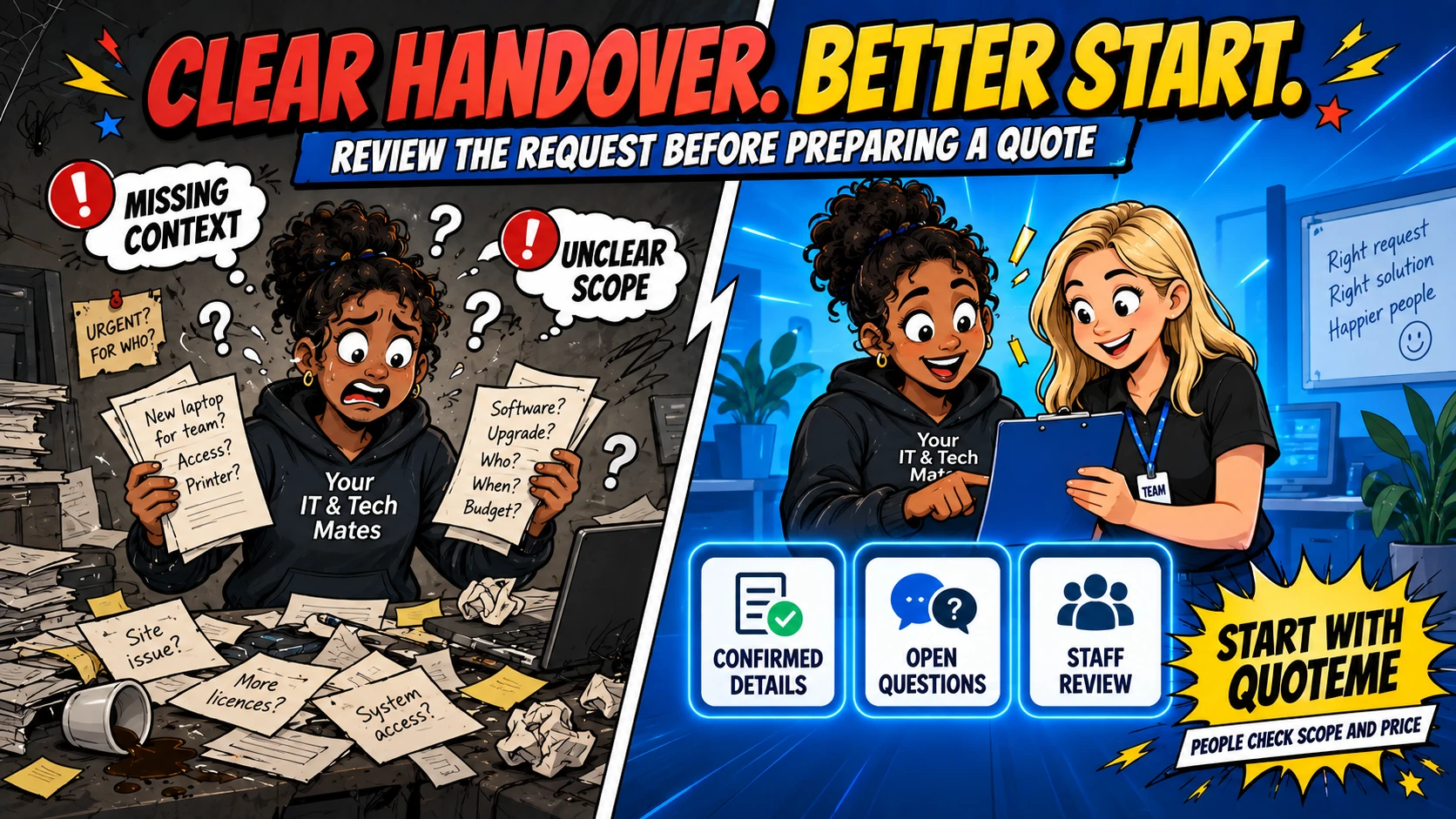
An internal quote handover summarises the request, confirmed details and unresolved questions. It helps staff prepare a quote, but it is not a final price, customer approval or a confirmed booking.
An enquiry and a quote do different jobs
An enquiry tells the business what the customer needs. A quote sets out the work being offered and the relevant price and terms. Moving from one to the other requires judgement, particularly when a device has not been inspected or a business request has several possible solutions.
QuoteMe gives customers a way to start a request. The virtual-admin preparation and review work helps staff organise the context behind that request. Neither a helpful summary nor a submitted enquiry should be mistaken for permission to begin paid work.
A worked example: a small office wants fewer interruptions
Imagine a fictional enquiry from an office where staff repeatedly lose access to a shared printer. The customer says three people are affected, the problem returns after temporary fixes, and they want someone to assess it outside their busiest period.
A weak handover might say “printer repair required”. That turns an unresolved problem into a particular service before anyone has checked the cause. A stronger internal handover preserves the observations and the practical constraint.
- Request: assess recurring shared-printer interruptions affecting three staff.
- Known: temporary fixes have not lasted; the office wants less disruption.
- Still to confirm: printer model, connection method and what the earlier fixes involved.
- Scheduling preference: discuss a time outside the busiest period; no appointment confirmed.
- Scope boundary: assessment needed before promising a repair or replacement.
The handover gives a colleague a place to begin. It leaves space for the actual quote to describe an appropriate assessment and any conditions the business needs to explain.
The review point protects the conversation
In our review workflow, staff can inspect prepared material before opening it in the existing case process. Customer-enquiry handovers stay with the request; business-case handovers can sit alongside the linked proposal workflow. Internal notes are not automatically inserted into the public proposal fields.
That separation matters because internal working notes may include uncertainties or reminders that need explanation before they belong in customer-facing text. Staff still write the scope, check the price and terms, and use the normal approval process.
Check what changed before using a saved handover
A customer might send a model number, correct the number of affected devices or explain that the issue has stopped. Staff should review the current conversation before relying on material prepared earlier. If the facts have changed, the handover and proposed next step may need to change too.
The same rule applies to a draft customer reply. A saved suggestion can save writing time, but it cannot replace checking the intended recipient, the current request and any promise in the message. Opening a handoff is preparation; the normal final action remains a staff decision.
What customers can include in a QuoteMe request
Start with what is happening and what you want help with. Include the device or system if known, when the problem began, any relevant steps already tried and a practical constraint such as when the equipment is available. It is fine to say that the cause is unknown.
You do not need to write an internal handover yourself. A plain-English explanation is useful. The team can ask for further details where they affect assessment or scope. Sending a request does not automatically confirm a price, time slot or repair outcome.
What another small business can take from this
When enquiries and quoting are handled by different people, define a short handover that preserves customer facts and labels uncertainty. Keep internal working notes separate from the offer the customer will receive. Make it clear who checks the final scope and who can commit the business.
The benefit to look for is a quote conversation that starts from the customer’s actual request. A neat summary has little value if it silently changes what the customer asked for or makes a promise the team has not approved.
Frequently asked questions
Does a QuoteMe request confirm my booking?
Submitting a request starts the enquiry process. Appointment availability and confirmation still need to be handled through the normal booking conversation.
Does the assistant set the final price?
No. The internal handover supports preparation. Staff remain responsible for the customer-facing scope, price and terms.
Will internal notes be copied into my proposal?
The reviewed handover is kept as internal context rather than automatically inserted into public proposal fields. Staff prepare the wording intended for the customer.
Continue the virtual-admin series
- How a Virtual Admin Assistant Helps a Small Team Manage Customer Enquiries
- Better Follow-Up Questions: Less Back-and-Forth Before Tech Support
- Clear Next Steps: Customer Follow-Up Reminders for a Small Office
Want help with your own office workflow?
Tell us where enquiries, quoting or follow-up work get stuck. Explore our small-business software and AI services or use the AI Opportunity Finder to think through a starting point.
Start with the problem in your own words
Need tech help or want to discuss a repeated office task? Tell us what is happening through QuoteMe. Our team can review the request and discuss the next step.