
Quick answer
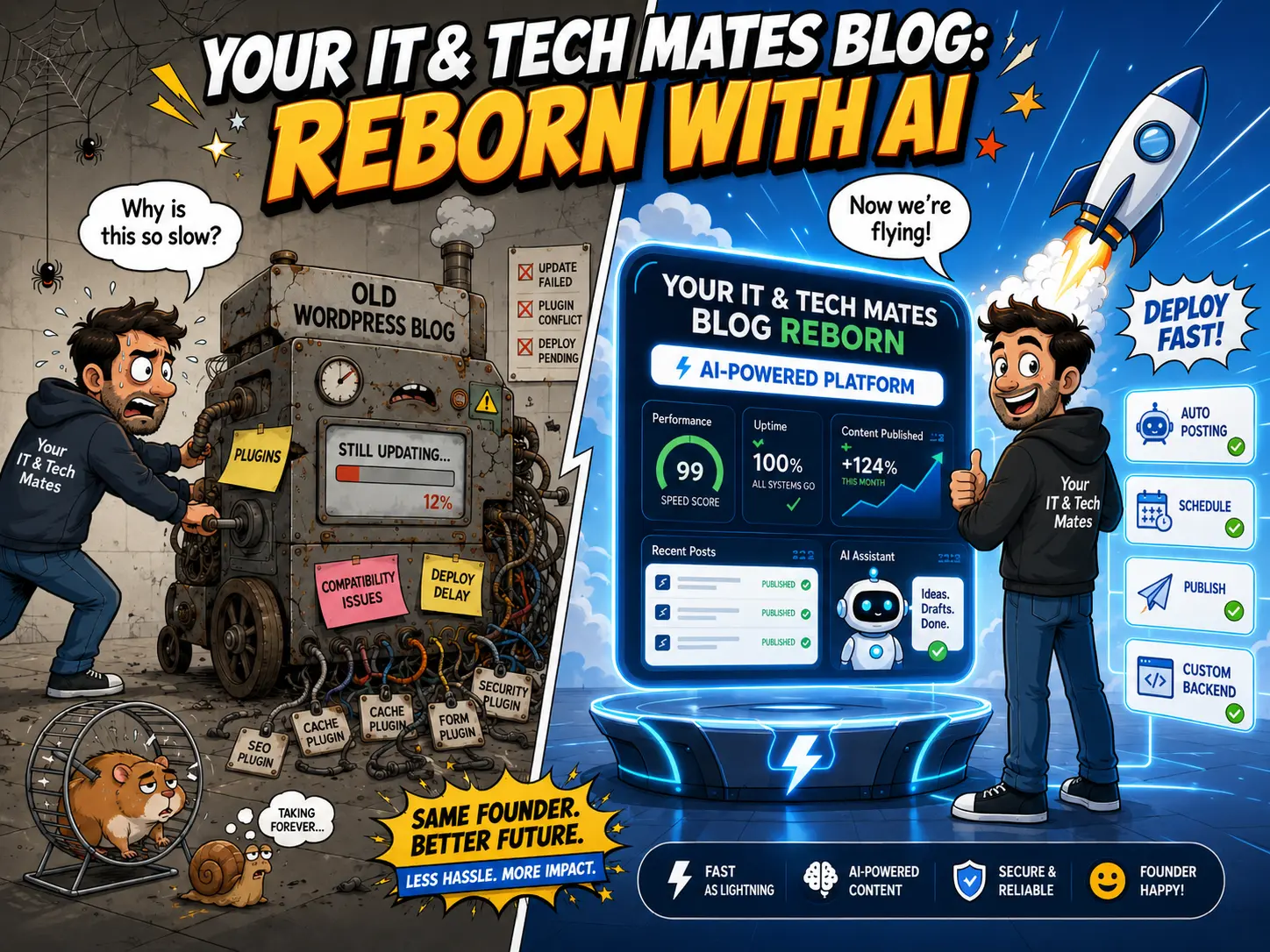
Moving away from WordPress was not simply a website decision for Your IT & Tech Mates. It was a business workflow decision.
We wanted to create a connected AI content workflow that could support research, drafting, branded image creation, SEO, generative engine optimisation, human approval, scheduling and automated publishing from one customised backend.
Previously, preparing and publishing a complete blog post could take around two hours. Our new AI-assisted workflow has the potential to reduce that process to around 30 minutes, depending on the subject, complexity and amount of human review required.
That is a potential time saving of up to 75%.
The project is also a practical example of what Your IT & Tech Mates can build for other businesses: custom AI integrations that solve a complete operational workflow instead of adding another disconnected AI tool.
Explore small-business software and AI solutions in Melbourne North →
Workflow at a glance
These figures are workflow estimates from this case study, not guaranteed savings. Complex or high-risk topics require more review.
Why moving away from WordPress felt difficult
WordPress had been part of our business for years.
We understood how it worked. We had built content around it, installed the plugins we needed and become familiar with its administration process.
That familiarity created a sense of safety.
Even when updates, plugin conflicts, formatting steps and deployment delays began adding friction, there was still an emotional reason to stay.
The question was not only:
Can we build something better?
It was also:
Should we let go of a platform that helped us get this far?
WordPress remains a useful content management system for many organisations. Our decision was not based on the idea that every business should replace it.
Our needs had simply moved beyond a traditional publishing workflow.
We wanted a platform that could be shaped around our business, our content process and our future AI integration plans.
The real problem was the workflow, not just the website
It is easy to look at content production as a writing task.
In practice, publishing a useful business blog post can involve:
- Selecting a customer problem or search topic.
- Researching the subject.
- Preparing an article outline.
- Drafting the content.
- Checking technical accuracy.
- Rewriting the content in the brand voice.
- Creating a suitable branded image.
- Choosing an SEO-friendly image filename.
- Writing accessible image alt text.
- Preparing the page title and meta description.
- Adding headings and structured content.
- Finding relevant internal links.
- Optimising the article for traditional search.
- Improving the content for AI-powered search and answer engines.
- Reviewing the article for quality and safety.
- Formatting the article in the website backend.
- Scheduling or publishing it.
- Sharing it through other channels.
When these steps are handled through separate tools and plugins, people spend a considerable amount of time copying information between systems.
The technology may technically work, but the overall process remains slow.
That is the type of problem Your IT & Tech Mates aims to solve through practical AI integration and workflow automation.
What we wanted from our AI-powered content platform
We did not want an automated system that published unreviewed AI content.
We wanted a controlled workflow in which AI could reduce repetitive work while people remained responsible for quality, accuracy and final approval.
Our custom AI content backend was designed to connect several important functions.
AI-assisted research and content preparation
The workflow can help prepare an initial topic structure based on a real customer question, service problem or business need.
It can support:
- topic research;
- customer search-intent analysis;
- article outlines;
- heading suggestions;
- frequently asked questions;
- first-draft preparation;
- plain-English explanations;
- content expansion; and
- brand-voice consistency.
A human still reviews the information, adjusts the tone and checks whether the advice is appropriate.
The objective is not to remove human thinking. It is to reduce the time spent starting from a blank page.
Human review and approval
Human approval remains an important part of the workflow.
Before an article is published, it can be checked for:
- technical accuracy;
- misleading claims;
- duplicated content;
- inappropriate recommendations;
- customer clarity;
- spelling and grammar;
- brand consistency;
- privacy concerns;
- safety risks; and
- whether the content genuinely answers the reader’s question.
AI can accelerate content preparation, but responsibility should remain with the business publishing the information.
Branded AI image creation
Creating a suitable image can add another significant step to the publishing process.
Our workflow is designed to support the preparation of images that match the topic and the Your IT & Tech Mates brand.
This can include:
- image concept generation;
- realistic or illustrated scenes;
- branded uniforms and visual elements;
- image dimensions for different platforms;
- SEO-friendly filenames;
- descriptive image alt text; and
- image prompts that can be reused or refined.
Integrating image preparation into the workflow reduces the need to move repeatedly between content, design and publishing tools.
SEO titles and meta descriptions
Search engine optimisation is more useful when it is part of the content workflow rather than an extra task completed at the end.
The backend can assist with:
- SEO title options;
- meta descriptions;
- natural keyword variations;
- heading structure;
- image filenames;
- image alt text;
- internal-link suggestions;
- topic clusters;
- related service pages;
- FAQ content; and
- clear answers suitable for search snippets.
The goal is not to repeat keywords unnaturally.
The goal is to help each page clearly communicate what problem it answers, who it helps and what information it contains.
GEO and AI-search optimisation
People are increasingly asking questions through AI assistants, answer engines and AI-powered search experiences.
This means useful content must be understandable not only to traditional search engines but also to systems that retrieve, summarise and quote information.
Generative engine optimisation, often called GEO, involves structuring content so that important answers are clear and easy to retrieve.
Our workflow supports this by encouraging:
- a direct answer near the beginning;
- clear question-based headings;
- concise definitions;
- self-contained paragraphs;
- natural FAQ questions;
- useful examples;
- consistent terminology;
- structured information;
- relevant entities and related concepts; and
- sentences that can be understood without excessive surrounding context.
GEO does not replace SEO.
A strong content strategy should support human readers, traditional search engines and AI-powered discovery at the same time.
Internal linking and content structure
Internal linking helps customers move from an educational article to related information.
It also helps search and AI systems understand the relationship between pages.
For example, an article about a slow laptop might naturally link to:
- laptop repair services;
- computer performance advice;
- storage upgrades;
- malware checks;
- data backup guidance; and
- a customer support or quote page.
Our customised backend can help identify these relationships and recommend appropriate links during the preparation process.
Scheduling and automated publishing
Once content has been approved, the workflow can support scheduling and automatic publishing.
This is more useful than simply generating a draft.
It allows the complete process to move through defined stages, such as:
Idea → Research → Draft → Image → SEO and GEO → Human Review → Approval → Schedule → Publish
The business retains oversight, but the repetitive movement between each stage can be reduced.
How much time could an AI content workflow save?
Before developing the new workflow, a complete blog post could take approximately two hours to research, prepare, format, illustrate, optimise, review and publish.
Our target AI-assisted process can potentially reduce this to around 30 minutes for a suitable article.
The actual time will depend on the topic and the amount of review needed. Technical, legal, medical, financial or high-risk subjects may require substantially more checking.
For a straightforward business article, the illustrative saving is:
- Previous process: approximately 120 minutes.
- AI-assisted process: approximately 30 minutes.
- Potential saving: 90 minutes per article.
- Potential reduction: 75%.
If a business publishes eight articles each month, saving 90 minutes per article could return approximately 12 hours to the team.
Using an illustrative internal labour value of $60 per hour:
- Potential monthly value returned: $720.
- Potential annual value returned: $8,640.
These figures are examples rather than guaranteed savings.
However, they show why workflow design matters.
Saving a few minutes with an isolated AI writing tool is useful. Connecting research, drafting, images, optimisation, review and publishing can create a much greater operational benefit.
Why we built a custom backend
A collection of plugins can provide many useful functions.
The challenge appears when a business needs several plugins, external platforms and manual steps to work together.
This can create:
- duplicated data entry;
- inconsistent formatting;
- plugin compatibility concerns;
- update risks;
- separate subscription costs;
- limited automation;
- slower deployment;
- unclear ownership of data;
- dependence on external providers; and
- workflows that do not match how the business actually operates.
By developing our own customised backend, we can build each capability around one controlled process.
We can also add new features directly into the platform instead of waiting for a suitable plugin or trying to make multiple plugins communicate with one another.
How AI supported the development process
AI did not build the platform without human direction.
We used AI as a development partner throughout the project.
It assisted with areas such as:
- defining the workflow;
- planning system components;
- exploring architecture options;
- generating and reviewing code;
- identifying possible errors;
- preparing test cases;
- improving interfaces;
- checking content structures;
- documenting functions; and
- refining features through repeated testing.
Human judgement remained necessary throughout the process.
Someone still needed to define the business problem, decide what the system should do, review the output, test the behaviour and reject unsuitable suggestions.
This is an important part of effective AI implementation.
The quality of an AI system depends heavily on the quality of the workflow, instructions, controls, testing and human decisions around it.
What this project demonstrates about Your IT & Tech Mates
Your IT & Tech Mates is known for practical technology support, but our capabilities are continuing to expand.
This project demonstrates our ability to combine:
- business workflow analysis;
- AI integration;
- custom backend development;
- process automation;
- content management;
- SEO support;
- AI-search and GEO preparation;
- automated publishing;
- user-interface design;
- testing; and
- ongoing platform improvement.
We are not interested in adding AI simply because it is popular.
We want to identify where a business is losing time, repeating work or struggling with disconnected systems.
We can then assess whether AI, automation or custom development could create a simpler and more controlled process.
AI integration should solve a business problem
Many organisations begin their AI journey by purchasing a new tool.
A better starting point is often the workflow itself.
Ask:
- Which tasks are repeated every day or every week?
- Where are people copying information between systems?
- Which approvals cause unnecessary delays?
- Which processes depend on one staff member remembering every step?
- Where are customers waiting for a response?
- Which reports are prepared manually?
- Which content or documents require the same formatting repeatedly?
- Where could AI assist without making the final decision?
- Which stages must retain human approval?
- How will the result be tested and monitored?
These questions help separate useful AI integration from AI experimentation that creates more work.
When a custom AI workflow may make sense
A customised AI system may be worth exploring when a business has:
- a repeated high-volume process;
- several disconnected software tools;
- substantial manual data entry;
- recurring content or document preparation;
- predictable review and approval stages;
- difficult plugin or platform limitations;
- specialised business rules;
- a need for stronger control over data and workflows; or
- an existing process that does not fit off-the-shelf software.
Custom development is not automatically the right answer.
Sometimes improving an existing platform or connecting two established tools is more practical.
The decision should be based on business value, cost, risk, maintainability and the time the new workflow could return.
What businesses should avoid when implementing AI
Automating an unclear process
Automating a disorganised process can make the confusion move faster.
The workflow should be understood before technology is added.
Publishing without human review
AI-generated content can contain incorrect, outdated or misleading information.
Businesses should define who reviews and approves important content.
Using too many disconnected AI tools
Adding several separate AI products may create more subscriptions, more data movement and more administration.
Look at the complete process before selecting tools.
Measuring output instead of outcomes
Producing more articles is not necessarily a business improvement.
Better measures may include time saved, customer questions answered, enquiries generated, support requests reduced or staff capacity returned.
Ignoring security and privacy
Businesses should understand what information is being sent to an AI provider, where it may be stored and whether personal or confidential data is involved.
Frequently asked questions
Is Your IT & Tech Mates completely replacing WordPress?
We are moving our own content workflow towards a customised backend because we need greater control and deeper AI integration. This does not mean WordPress is unsuitable for every business. The right platform depends on the organisation’s requirements, budget and workflow.
Can AI create and publish an entire blog post automatically?
It can assist with research, drafting, images, metadata, scheduling and publishing. However, human review is still recommended, particularly where the content includes technical advice, safety information or important business claims.
What is an AI content workflow?
An AI content workflow connects the stages involved in preparing and publishing content. It may include research, drafting, editing, image creation, SEO, GEO, approval, scheduling and automated posting.
What is generative engine optimisation?
Generative engine optimisation, or GEO, is the practice of making content clear and structured for AI-powered search and answer systems. It complements traditional SEO by helping AI systems identify, understand and summarise useful information.
How can AI improve SEO?
AI can help identify what customers are looking for, organise headings, prepare metadata, suggest related phrases, create image alt text and identify internal-link opportunities. These suggestions still need human review and should not be used for keyword stuffing.
How much time can content automation save?
The saving depends on the original process and the level of review required. In our example, reducing a two-hour workflow to around 30 minutes could save 90 minutes per article, or approximately 12 hours per month across eight articles.
Can Your IT & Tech Mates build AI workflows for other businesses?
Your IT & Tech Mates can assess business processes and explore practical options involving AI integration, workflow automation and custom development. The recommended approach depends on the process, systems, data, risks and expected business value.
Does every business need a custom AI backend?
No. Some businesses will receive better value from improving their current software or integrating existing tools. A custom backend is most useful when standard software cannot support an important or specialised workflow efficiently.
Building AI around the business, not forcing the business around AI
Moving away from WordPress was not a rejection of the platform that helped us build our foundation.
It was recognition that our workflow had changed.
We needed a system that could connect content preparation, image creation, SEO, GEO, human approval and automated publishing in one controlled process.
The result is more than a new blog backend.
It is a practical case study in how Your IT & Tech Mates approaches AI integration: understand the business problem, map the complete workflow, keep people in control and build technology that produces measurable value.
For businesses exploring AI workflow automation, custom software or practical AI integration, Your IT & Tech Mates can help identify where time is being lost and what a safer, simpler process could look like.
Discuss a workflow problem
Start with the repeated task, approval delay or disconnected system, not with an AI product. We can help assess whether integration, automation, an existing tool or custom development is the practical next step.