
How We Keep AI Costs Under Control
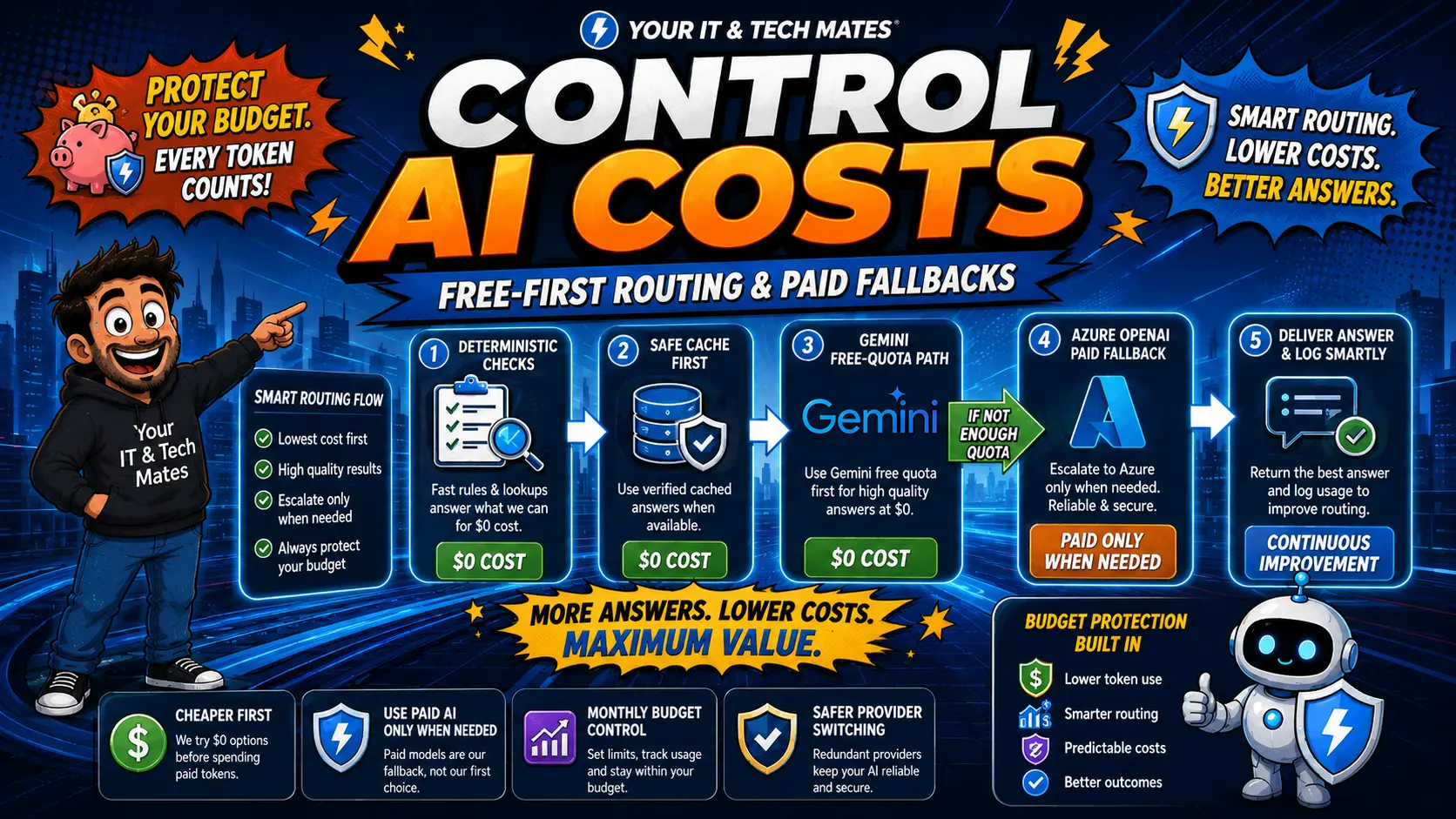
Our server chooses when AI is worth using, tries the lower-cost option first where suitable and only uses a paid backup within firm limits.
Quick answer
Our server chooses when AI is worth using, tries the lower-cost option first where suitable and only uses a paid backup within firm limits.
The practical problem
Public AI can become expensive if every question goes straight to a paid service or if website visitors can influence which AI is used. Cost controls need to live on the server, not only in browser code.
What we built
We keep AI service choice, request size, spending limits and how many requests can run at once under private server rules. Where suitable, the system can try the lower-cost option first and use a guarded paid backup only when the rules allow it.
How the workflow works
- A website feature asks whether outside AI help is suitable.
- The server checks the request size, current limits and how many AI requests are already running.
- The lower-cost configured option is considered first where it fits.
- A paid backup is considered only when it is allowed and within the spending limit.
- If outside AI is unavailable or not suitable, the website returns a controlled non-AI or simpler fallback instead of spending without limit.
Where AI is useful
Outside AI services are used for language work only after the server has decided that the request is suitable and within the current limits.
Where AI is not allowed to decide
A visitor cannot force a more expensive AI service, increase the spending limit or bypass the business rules. AI service costs are also not the same thing as customer pricing.
Security, privacy and cost controls
Usage limits, request limits and spending controls are stored and enforced on the server. If important cost-control information is damaged or cannot be read safely, the system blocks extra paid use rather than assuming there is more budget.
What another small business can take from this
Before adding AI, decide who controls service choice, what deserves an AI request, the maximum spend, what happens when the AI service fails and what useful non-AI option remains.
What this does not prove
These controls reduce unexpected spending but do not promise a fixed monthly saving. Real cost still depends on traffic, outside AI pricing and how often safe existing answers can be used instead.
Part of our smarter website project
This implementation story is one part of a larger Your IT and Tech Mates project exploring how practical AI, automation, trusted business knowledge and human-controlled workflows can work together.
Frequently asked questions
Can a website visitor choose the paid AI service?
No. AI service choice and spending rules stay on the server.
Do you always send a question to AI?
No. Simpler website logic or a safe reusable answer may be enough.
What happens when the first AI option is unavailable?
A paid backup is considered only if the rules and spending limits allow it; otherwise the website uses a controlled fallback.
Can AI spending go past the server limit?
The system is designed to block extra paid use when the limit is reached or important cost state cannot be trusted.
Does lower AI cost mean lower customer prices?
Not automatically. AI service cost is an internal operating cost, not a customer quote.
Related Your IT and Tech Mates help
Could a similar workflow help your business?
Tell us how the process works today. We can look at whether better website logic, automation, custom software, AI—or something simpler—would be useful. A person reviews the request before any scope or price is agreed.