
How We Reduce AI Costs by Safely Reusing Good Answers
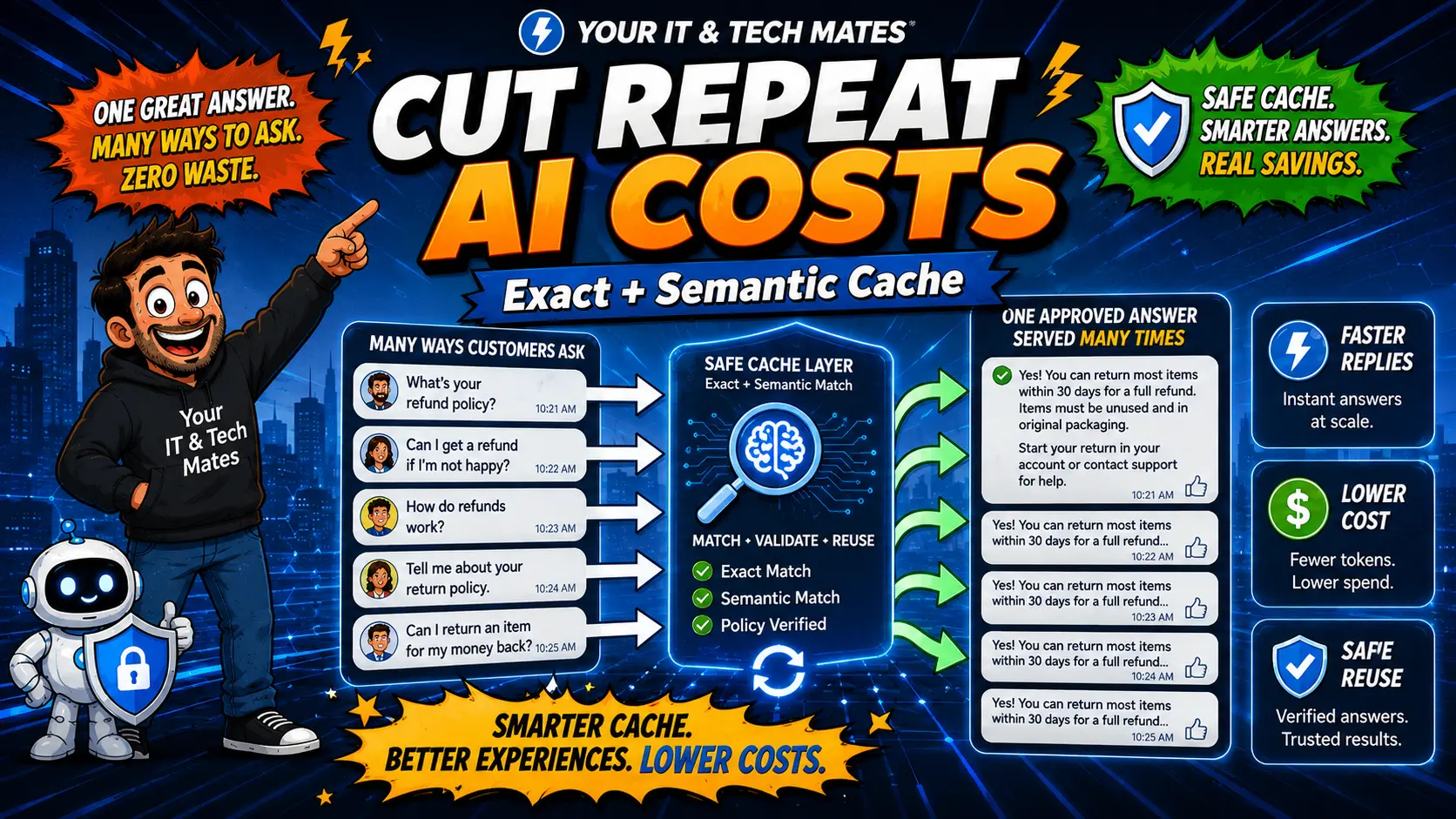
When customers ask the same safe question in different words, the website can reuse an approved answer instead of paying for another AI request—after checking it is still current.
Quick answer
When customers ask the same safe question in different words, the website can reuse an approved answer instead of paying for another AI request—after checking it is still current.
The practical problem
Sending every similar customer question to an outside AI service can add cost and delay. The harder part is making sure an old or only vaguely similar answer is never reused when it no longer fits.
What we built
We built a safe answer-reuse system. It can recognise an exact repeat or, where allowed, a very similar question. Before reusing anything, it checks that the saved answer is valid and still tied to the current reviewed business information.
How the workflow works
- A customer question reaches the normal help flow.
- The website checks for a safe exact match to a recent answer.
- Where the rules allow it, the website can also recognise a meaningfully similar question.
- A valid current answer can be reused without another paid AI request.
- If there is no safe match, the request continues through the normal answer process.
- When reviewed business information changes, old saved answers stop being treated as current.
Where AI is useful
AI is not needed to reuse an already approved answer. An outside AI service is considered only when safe reuse and simpler website logic are not enough.
Where AI is not allowed to decide
The reuse system cannot invent a new fact, change a price, approve work or make an unsafe AI answer trusted.
Security, privacy and cost controls
Saved-answer data is checked before use. Unknown or damaged entries are ignored, and safer file-writing steps are used when the system saves updated information.
What another small business can take from this
Reusing answers can be worthwhile when many customers ask repeatable questions and the answer is tied to stable business information. It is less suitable for personal, fast-changing or high-risk decisions.
What this does not prove
We do not turn every reused answer into a public “dollars saved” claim because we cannot always know exactly what outside AI service would otherwise have been used.
Part of our smarter website project
This implementation story is one part of a larger Your IT and Tech Mates project exploring how practical AI, automation, trusted business knowledge and human-controlled workflows can work together.
Frequently asked questions
How can the website reuse an answer when the wording is different?
It can recognise a closely equivalent question only where the reuse rules say that is safe.
What happens when business information changes?
The website stops treating older saved answers as current when the reviewed source information changes.
What happens if saved-answer data is damaged?
It is ignored and the website continues through the normal answer process.
Does every reused answer equal a known dollar saving?
No. Reuse reduces unnecessary outside AI requests, but the exact avoided cost is not always certain.
Does this create a customer profile?
No. The feature is for safe answer reuse, not for building a customer profile or CRM record.
Related Your IT and Tech Mates help
Could a similar workflow help your business?
Tell us how the process works today. We can look at whether better website logic, automation, custom software, AI—or something simpler—would be useful. A person reviews the request before any scope or price is agreed.