
How QuoteMe Reuses Journey Context Without Auto-Submitting a Request
The quote workflow begins with what the website already understands, but the customer remains in charge of what gets sent.
Quick answer
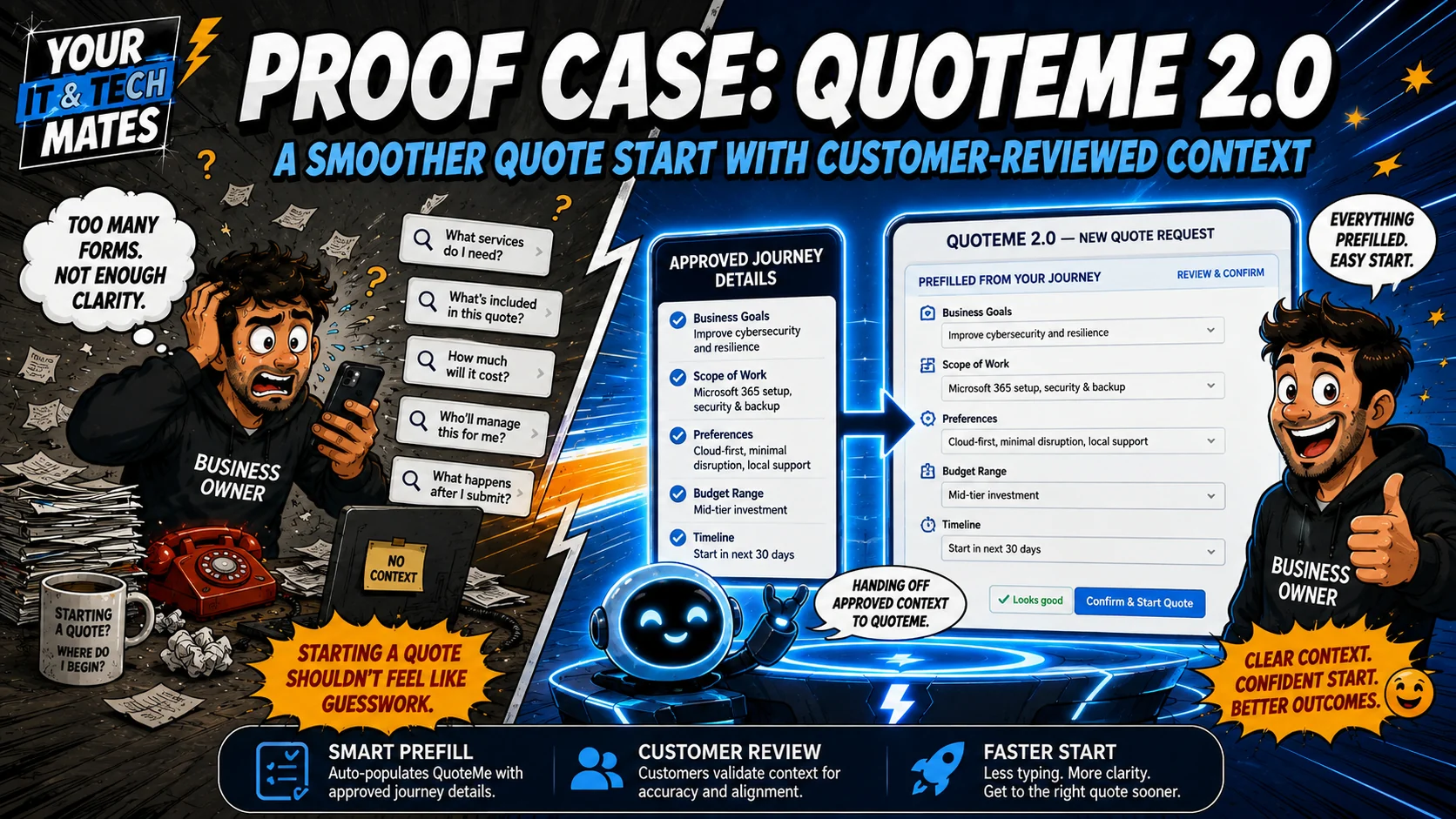
We upgraded QuoteMe so confident resolved journeys can preselect the closest existing choices, show what is already understood and move to genuinely missing details. The customer can change inherited choices and must explicitly submit the request.
The practical problem
A website can look intelligent on one screen yet still make a customer restart when they move to the next page, form or staff handover. We wanted the intelligence to continue across the journey without creating a second request system or giving automation authority it should not have.
What we built
A reusable journey-to-quote connection with Your IT & Tech Mates service mappings that translate resolved intent and secondary needs into a safe starting plan for the existing QuoteMe workflow.
How the workflow works
- The current journey resolves a primary need and optional bounded secondary needs.
- QuoteMe reads the server-side journey rather than trusting hidden browser fields.
- Known choices are prepared as editable starting selections.
- The customer sees a concise summary of what is already understood.
- QuoteMe asks for missing details and preserves required safety questions.
- The customer explicitly submits through the existing request owner.
- Staff receive structured context for human diagnosis, scope and pricing review.
Evidence we can show
The implementation keeps QuoteMe as the only structured new-request owner and explicitly blocks automatic quote approval, diagnosis, payment, booking and paid-work authorisation.
Human and safety boundaries
The journey may interpret, organise, recommend and prepare. It does not silently submit QuoteMe, authenticate a customer, approve final pricing, authorise payment or approve paid work. High-risk states continue to override ordinary commercial routing.
What this does not prove
Prefill is not proof that the inferred problem is technically correct. The customer can change the selection and a technician remains authoritative for final diagnosis, scope and price.
Frequently asked questions
Does this create a second customer or request system?
No. The journey layer coordinates existing owners. QuoteMe remains the structured new-request owner and verified customer systems remain responsible for existing requests.
Can the system automatically approve a quote or paid work?
No. Final scope, diagnosis, pricing and paid work remain under the existing human-controlled process.
Is raw customer conversation stored in journey analytics?
No. Journey analytics uses structured outcome events rather than raw enquiry wording.
What happens when the system is unsure?
Clarification or staff review takes precedence over pretending to have a confident answer.
Related Your IT and Tech Mates guidance
Could a similar customer journey help your business?
Tell us where customers repeat themselves, choose the wrong path or get stuck between your website and your real workflow. We can review whether better software, automation, AI—or a simpler process change—would help. A person confirms scope and pricing before paid work starts.
Connect this guide to the wider Software & AI library
This topic is part of a wider customer-journey system. Use these related guides and first-party implementation examples for the next layer of detail.