What you need to know
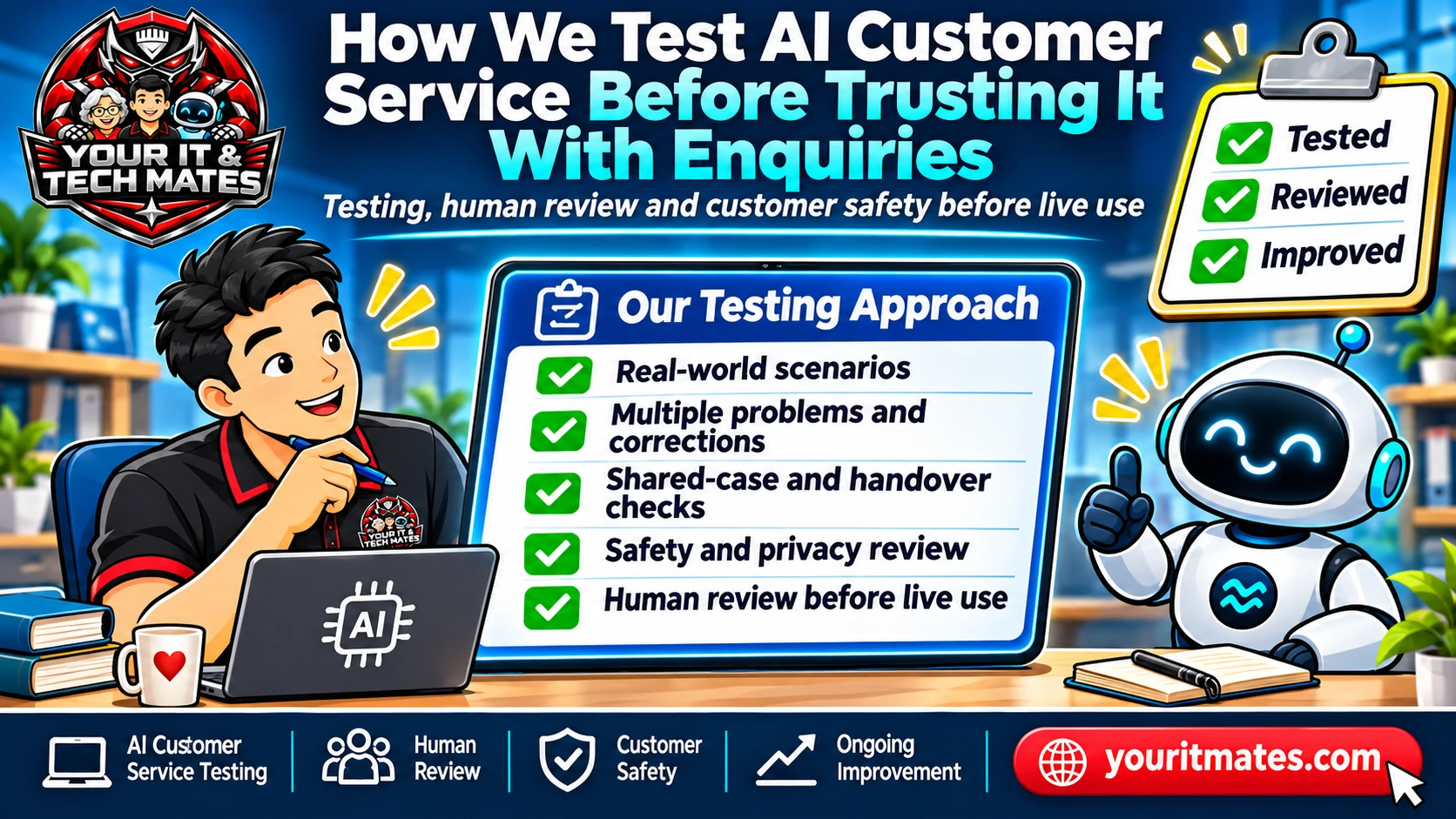
A confident-sounding AI answer is not evidence that a service journey works. Test corrections, multiple problems, urgent safety scenarios and the handover to a person. Separate synthetic regression results from actual mobile-browser and production checks before releasing changes.
Three useful things to note
- Test messy language, multiple faults and changed device details.
- Check immediate safety guidance, accurate handovers and user consent.
- Require human review and independent live verification before release claims.
Why happy-path demos are not enough
A polished demo usually follows a clean sequence. Real enquiries start with 'it just stopped', mix two devices, change a model name or interrupt repair questions to ask about collection. A system can appear intelligent while quietly dropping the original problem.
Useful quality assurance reproduces these awkward turns on purpose. It compares what the customer actually said with the structured case and asks whether the next response was safe, relevant and honest about uncertainty.
Build a representative test set
Include laptop power faults, cracked screens, unstable Wi-Fi, liquid damage, suspicious messages, senior-accessibility needs and small-business software requests. Vary spelling, sentence length, device knowledge, multi-problem descriptions and the order in which facts arrive.
Each scenario needs observable expectations: which concerns are retained, which questions are relevant, which statements remain uncertain and whether the customer can move to review without being trapped in a help-only route. Do not score a helpful-sounding answer as a pass if its handover loses data.
Put safety ahead of completion rate
A swollen battery, smoke, overheating or liquid intrusion can require immediate guidance rather than an ordinary quote CTA. The test should assert that the danger signal is prominent in the result itself, not buried in unrelated content below the fold.
Testing also checks that the assistant avoids speculative diagnoses, unsafe experiments and unrelated troubleshooting links. The system should let customers reach qualified human help without encouraging them to keep using a potentially unsafe device.
Check memory, corrections and permissions
If a customer says 'Dell' and then 'actually Lenovo', the new summary must show Lenovo and should not silently preserve the wrong model as current fact. A user asking about pickup should receive the service answer and still be able to continue the repair enquiry.
Test that known answers are not repeated, multiple faults remain separate and preferences are not treated as bookings. Sensitive inputs should not be copied into public logs or training examples; reviewable summaries must respect privacy and consent boundaries.
Separate test evidence from live evidence
Unit and integration tests show that particular code paths behaved as expected in a controlled environment. Browser tests reveal layout, keyboard handling, navigation and confusing wording. Production-readiness review also depends on deployed revision evidence, operating conditions and signoff.
YITM's staged Adaptive Intelligence checks are part of this process, but 'the test script passed' is not the same as 'every live journey passed'. Where the deployed version or independent gates cannot be verified, the public claim should state that limitation.
Let humans approve changes and releases
Conversation-derived insights can suggest an improved question or knowledge article, but those suggestions need technical and editorial review before becoming authoritative. A safe workflow records proposed changes, compares new behaviour against baseline cases and supports rollback.
The same discipline applies to content: a synthetic scenario is labelled as such; a customer repair case needs evidence and consent. Neither a model-generated quote nor an invented customer outcome should be published to make a feature sound more mature.
What business owners can borrow
Start with five to ten common enquiries, then add unusual cases that are most likely to cause harm or confusion. Capture expected outcomes before tuning prompts or rewriting forms. Retest after each meaningful change rather than trusting one polished demonstration.
Ask a second reviewer to follow the journey as a nontechnical customer. If they cannot tell whether they have requested help, accepted a quote or booked a visit, the UX still needs work—even when the automated checks are green.
Frequently asked questions
Does passing an AI test prove the service is safe?
No. It provides evidence for the tested conditions; live behaviour, deployment, safety reviews and human signoff must also be considered.
Why test the same request with spelling mistakes?
Customer language varies. Robust flows must preserve meaning without inventing missing facts.
Can customer conversations automatically train the system?
A responsible approach does not treat raw customer data or unreviewed examples as approved learning material.
What is the most important release check?
Safety, continuity, accurate handover and clear user consent matter more than fluent-sounding messages alone.
Need help with your own situation?
Tell us which customer workflow is causing unnecessary work. We can discuss practical options, integration boundaries and human review before any proposed software work is scoped.
Discuss your business workflow Explore more software and ai for business articles