
Stop
Do not wait until the last minute if the issue affects study, campus work, proof of experience or a device you need for class.
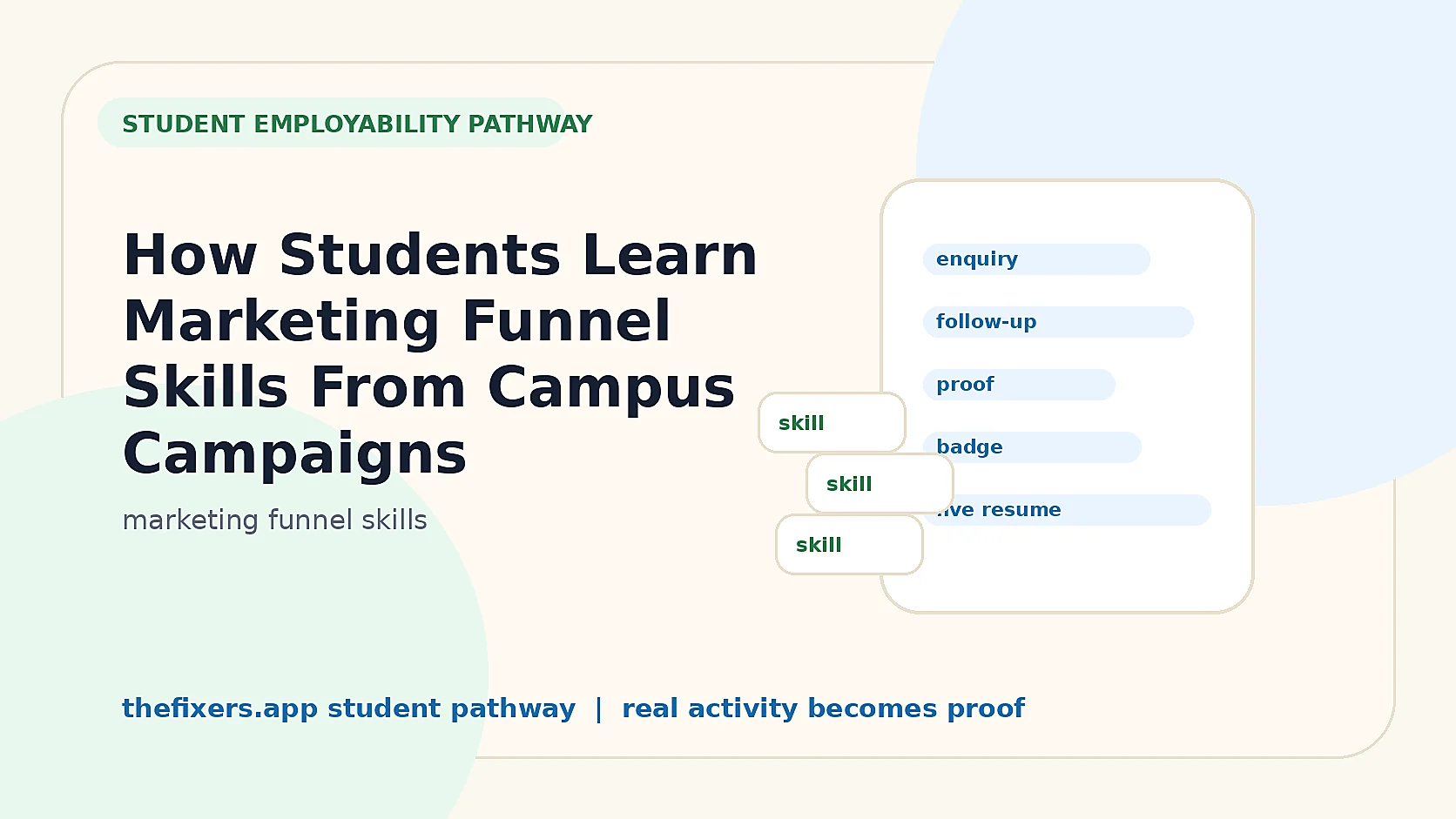
Students can learn customer journey skills from campus campaigns when they understand awareness, enquiries, follow-up, proof, referrals and repeat trust.
Student experience pathway
TheFixers.APP pathway is designed for students who need practical experience before they already have a long work history. A student can start with small, safe tasks, build confidence, collect reviewed proof, and turn that activity into a clearer Live Resume story.
This guide is organised for quick decisions, safer checks and clearer next steps.
Students can learn customer journey skills from campus campaigns when they understand awareness, enquiries, follow-up, proof, referrals and repeat trust.
Use the guide to choose the right next step and avoid spending time or money in the wrong place.
Keep the model, symptom, photos, error messages and timing together before asking for help.
Use this guide first, then choose Quick Help or the most relevant local service page.
Do not wait until the last minute if the issue affects study, campus work, proof of experience or a device you need for class.
Read the practical steps, gather the details you already have and choose the pathway that best matches your situation.
Use the linked pathway or Quick Help if you need a real person to point you to the next step.
Choose the step that solves the real problem first, then avoid adding extra tools, bookings or work until the next action is clear.
A campus campaign is a practical way for students to learn real marketing. They can see how awareness turns into enquiries, how follow-up builds trust and how proof supports the next conversation. Through thefixers.app, students can connect real activity to skill recognition, guidance, reviews, Team Up, customer updates and live-resume proof.
Students often have useful ability before they have formal work experience. They may be good at organising people, asking questions, writing updates, following up, introducing classmates to support, tracking a small campaign or helping a team finish a project. Those are real workplace skills when they are practised in a clear, safe and accountable way.
The student pathway should not only be about hands-on tech help. It should also recognise campus support, referral work, ambassador activity, business development, marketing campaigns, admin follow-up, customer support and project coordination. This gives more students a reason to join, including students studying business, marketing, communications, education, IT, community services or project management.
The app already includes pathways that support this topic: referrals, ambassadors, customer support, job boards, guidance, skill tags, Team Up, activity tracking and live resume proof. The blog should make those features easy for students to understand in plain language.
This topic helps students build skills that employers, schools, campuses and local organisations can understand. The value is not only the task itself. The value is the behaviour around the task.
A student might help organise a small campus awareness activity. They do not need to be the technical person. They might share a landing card, explain the student pathway, collect questions, help someone request support, follow up with a classmate, record what happened and check whether the work needs guidance.
That experience can become interview proof. The student can say: “I helped run a small campus pathway activity, tracked enquiries, followed up respectfully, coordinated next steps and recorded approved outcomes on my live resume.” That is much stronger than saying “I am organised” without proof.
On-campus help can include practical support, peer guidance, event support, student referrals, admin tasks, digital help, customer updates, student ambassador activity and small team projects. The app structure gives students a safer way to contribute without pretending they can handle every job alone.
For Melbourne's north and other local communities, this also helps schools, TAFEs, universities, families and local businesses see the pathway as structured. Students are not just doing random favours. They are learning workplace habits through real, guided activity.
Proof should be specific. A student can record the activity, the role they played, the communication they used, the follow-up they completed, the guidance they requested, the review they received and the skill tags connected to the work.
This matters because employers can understand a clear example. “I helped manage follow-up for a student support request and recorded the outcome” is more believable than “I am good at teamwork”.
A strong student pathway gives different types of students a place to start. Technical students can help with practical support. Non-technical students can help with referrals, communication, admin, marketing, people coordination and project support. Experienced students can lead teams or support newer students.
That makes the signup message broader and more motivating: join the pathway, start with a role that fits you, build real skills safely, and turn real activity into proof for your future.
Yes. The pathway can recognise communication, admin, marketing, customer support, organisation, people management and project skills, not only technical help.
It turns real activity into examples students can explain in interviews: what they did, how they communicated, what they organised and what outcome was recorded.
Yes. These workflows can support campus campaigns, student referrals, peer support, Team Up projects, practical help requests and school or campus partnerships.
Students should use clear boundaries, avoid pressure, protect private information, ask for guidance when unsure and only claim proof from real approved activity.
Proof can include approved reviews, skill tags, role notes, campaign activity, follow-up completed, team contribution and clear outcomes.
Start with a small role such as asking questions, sharing a landing card, helping with follow-up, taking notes or supporting a guided team project.
It shows the pathway is structured, safe and focused on workplace readiness rather than casual, unclear student work.
Students can contribute through practical help, campus support, referrals, ambassador work, organisation, people management, customer support and project coordination.
Keep building proof