Student experience pathway
How this helps students gain real experience while studying
TheFixers.APP pathway is designed for students who need practical experience before they already have a long work history. A student can start with small, safe tasks, build confidence, collect reviewed proof, and turn that activity into a clearer Live Resume story.
Experience students can gainPhone setup, laptop basics, Wi-Fi checks, Microsoft 365 help, digital confidence support, referral sharing, campus support and customer communication.
Proof students can collectCompleted tasks, sign-off notes, reviews, skill tags, guided reflections, before-and-after examples and safe helper records.
What they can show laterMateCard profile, SkillStack progress, Proof Missions, Live Resume examples and interview-ready stories that explain what they actually did.
Safe next step: start with a beginner-friendly task, stay inside the guidance boundaries, ask for review when unsure, and only claim proof for work that was genuinely completed.
Quick answer
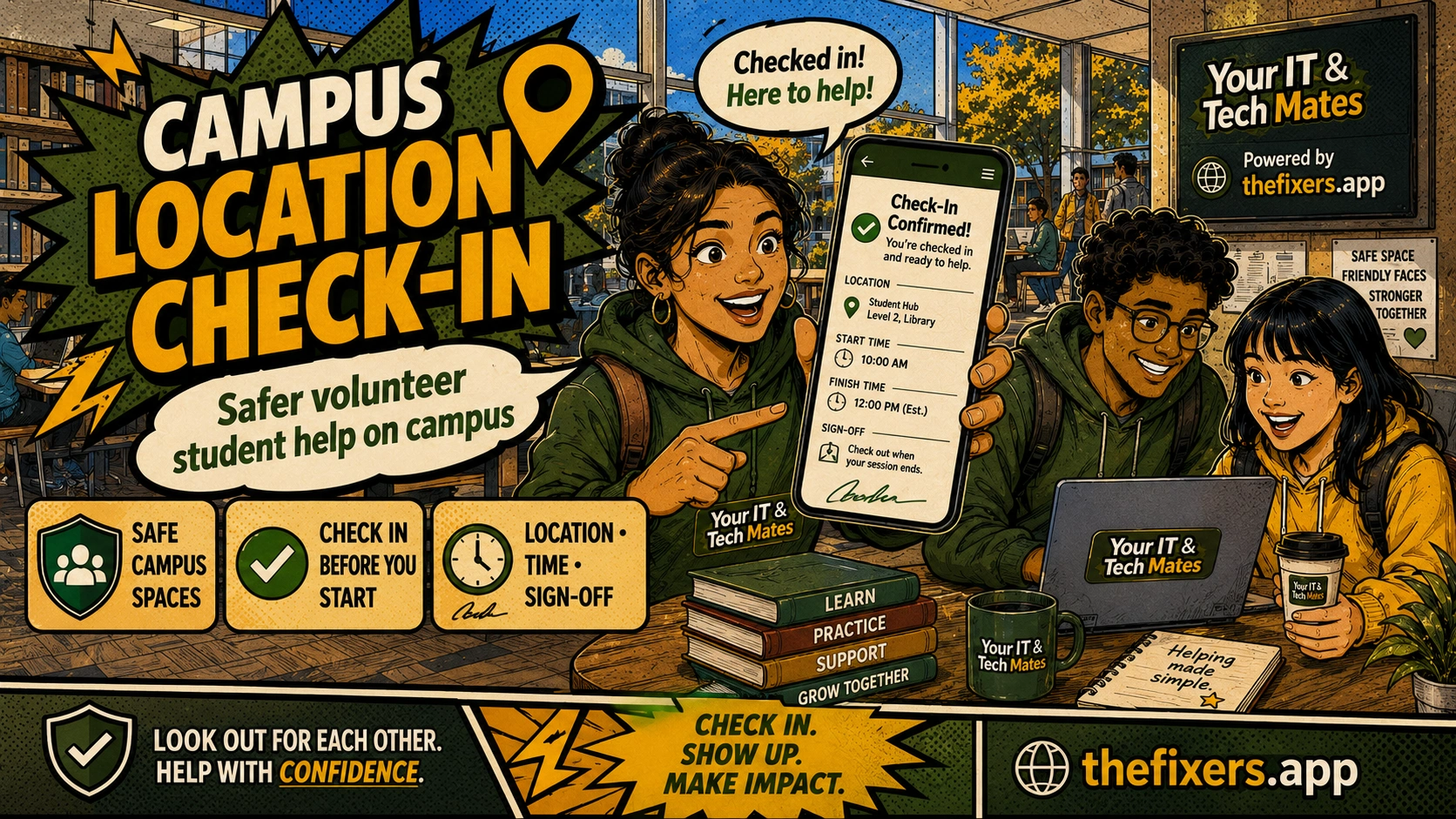
Students should complete volunteer or peer help in a safe public campus location, record the location before starting, track start and finish time, then use the existing review and sign-off flow to confirm the result.
campus location check-instudent volunteer safetystudent help on campuslocation proof
What to do today
- Choose a safe public campus location before the help starts.
- Use the browser check-in button if asked and allow location only for that check-in.
- Start the help, finish it, then let both users sign off through the existing review flow.
Why this makes students want to use the system
One clear safety ruleStudents know the work should happen on campus in places like a library, lab, student hub or supervised classroom.
Proof that feels realStart time, finish time, duration and location help show that the work actually happened.
Better resume storyThe student can explain what they did, where it happened safely and what result was confirmed.
Safety and anti-cheating rules
- No private homes or unsupervised private meetups.
- No continuous tracking; use one-time check-in only.
- No passwords, login codes, private documents or assessment answers.
- If the location is not safe, pause and ask for review.
How this connects to MateCard, SkillStack and Live Resume
Each completed, reviewed action should become approved proof rather than another disconnected task. Location check-in, duration, sign-off, rating and review help turn campus help into a safer proof story.
| Feature | How it helps |
|---|
| MateCard | Shows a simple proof profile and readiness signal. |
| SkillStack | Connects the task to real skill tags. |
| Live Resume | Turns the result into an interview story. |
| Review and rating | Uses the existing customer-style trust pattern. |
Common questions
What is the main point of Campus Location Check-In: Safer Volunteer Student Help on Campus?
Students should complete volunteer or peer help in a safe public campus location, record the location before starting, track start and finish time, then use the existing review and sign-off flow to confirm the result.
Does this replace existing MateCard, SkillStack or Live Resume features?
No. This guide explains how the existing student proof, review, sign-off and sharing features work together without creating a duplicate system.
What should students do first?
Choose a safe public campus location before the help starts.
Keep building proof
Student pathway links
Student outcome guide
What a student can actually gain from this
This pathway is not only about earning a small amount of money or helping a neighbour once. The real value is the proof trail. Each safe task can become a small example of reliability, communication, care, problem-solving and follow-through.
Beginner-friendly tasks that can build confidence
- Helping someone set up a phone, app, email account or basic cloud storage with guidance.
- Explaining simple steps in plain English for a senior, parent, student or neighbour.
- Checking simple Wi-Fi, printer, laptop or account setup issues without touching risky systems.
- Sharing the right help card or referral link when the job needs a more experienced provider.
- Writing a clear summary of what was checked, what was fixed and what should happen next.
What proof can go into MateCard, SkillStack and Live Resume?
Students can show completed tasks, customer-style sign-off, reviewed notes, skill tags, safe help boundaries, communication examples and reflections on what they learned. This is stronger than saying “I am good with technology” because it gives a practical example.
How this helps future job interviews
A student can explain the situation, the task, the action they took, the safety boundary they followed and the result. That gives them real interview stories for customer service, IT support, administration, community work, business, tutoring and local service roles.