Why Your Business Website Gets Visitors but Few Enquiries
Practical checks for Melbourne small-business websites with visitors but few enquiries: trust, mobile forms, service clarity and follow-up.
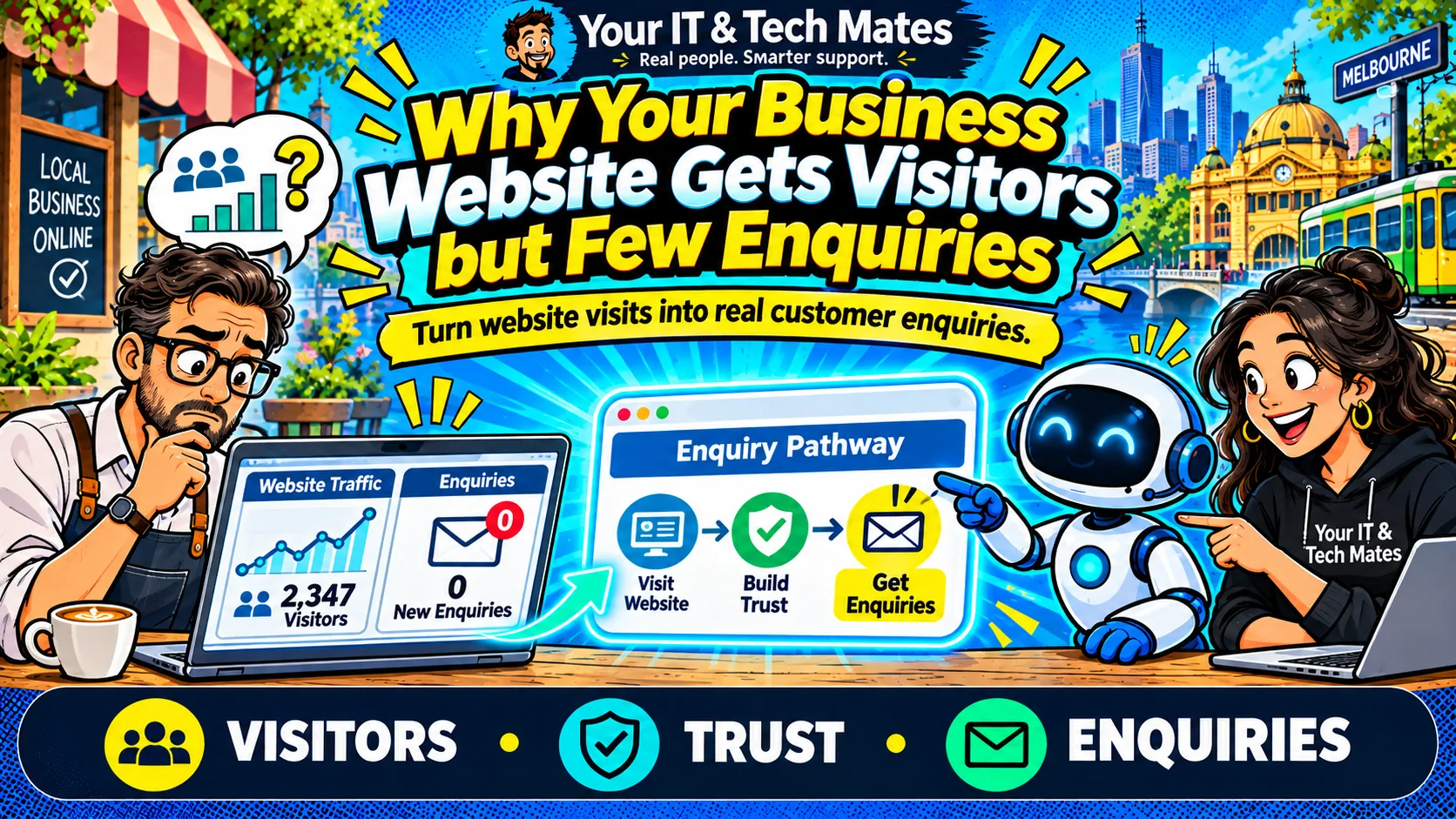
Illustrative guide. The artwork does not represent verified customer results or measured business metrics.
In brief: The right website decision depends on the customer journey, practical scope and honest evidence—not a sales pitch for one platform.
Why traffic alone cannot tell you whether a website works
A page view does not show whether a visitor understood your services, trusted your business or could send a useful request. Start with the path between the question that brought them to the site and the next action you want them to take.
Check the customer journey on a phone
Open the page on a mobile device. Are services, service areas and contact options easy to find? Test the enquiry form safely: required fields, error messages, confirmation and whether your team actually receives a notification. A broken or confusing hand-off may matter more than a new website design.
Answer real customer questions
Use everyday wording. Explain how an enquiry works, what information helps and when a human will respond. For Melbourne North customers, include Epping and Wollert where services are genuinely available; avoid repetitive location stuffing.
When AI-assisted enquiries are worthwhile
A simple contact form is often enough. More complex jobs may benefit from a guided enquiry that can ask one helpful follow-up question and preserve the customer's own description. Our QuoteMe and Virtual Receptionist work shows this approach, but it should never invent a price or commit to an appointment.
Measure the outcome
Compare relevant Google Search Console queries, form starts, form completions, qualified requests and first-response time across consistent periods. A high page-view count is not proof of business growth.
What to check before spending money
Keep a short troubleshooting record: the pages visitors arrive on, the action offered on those pages, whether the form works on a phone and which team member receives a completed enquiry. Check that the message is acknowledged without promising an unreviewed quote. If the problem is only an unclear contact option, change that before buying a larger platform.
Frequently asked questions
Does a business need an AI chatbot to get enquiries? No. A clear website and reliable contact pathway come first. Can you measure conversions without collecting sensitive information? In many cases, counts of form starts and completions provide useful operational signals, provided analytics and privacy controls are appropriate.
A 30-minute enquiry journey audit for your business
Start by choosing one realistic customer question, such as “Can you help with a laptop used for work?” or “Can you fix the online quote form on our business website?” Use a private browser window on a phone and try to complete the journey without relying on what you already know about your business. Write down the first page visited, how clearly it explains the service, whether a contact option is obvious and how many unnecessary decisions the visitor must make.
Then submit a clearly labelled internal test enquiry, rather than creating a fake customer record. Confirm that it reaches the correct inbox or staff queue, triggers an understandable acknowledgement and can be followed up. Test what happens when a required field is missed, a phone number is entered with spaces, or the visitor changes the requested service. Any step that fails is a specific improvement opportunity—not automatically a reason to replace the website.
Finally, assign the gaps to three buckets: information (unclear services or prices), interaction (navigation or form friction) and operations (slow or lost follow-up). Fix the least expensive verified problem first and repeat the test.
What an Epping or Wollert service business should put above the fold
An electrician, bookkeeper, mobile technician or IT support provider serving Melbourne North should make their actual service, service area and next step understandable on a small screen. A local visitor may be deciding whether the business serves Epping or Wollert, whether an appointment or remote conversation is possible and what happens after an enquiry is sent. Only claim suburbs and service types the business genuinely supports.
Use plain language such as “Tell us what you need help with” rather than forcing people to select a technical category they do not understand. For more complex requests, an editable summary is often more useful than a long form. Explain whether an estimate is indicative or whether the team must review the job first. Clear expectations can prevent follow-up messages and misunderstandings.
Prioritise improvements without assuming the answer is AI
Rank issues by customer impact and implementation effort. A broken submit button is urgent and usually more valuable to fix than adding a chatbot. A contact form asking for the same details twice may be a simpler fix than deploying a new CRM. A frequently misunderstood service description may need better examples and FAQs, not another automation provider.
If customers often describe two problems at once, send corrections, or need different routes for repairs and business software, guided intake can make sense. A sensible trial should compare a straightforward form with the proposed assisted flow using safe test scenarios, completion quality and human review workload. The purpose is a clearer enquiry, not more AI messages.
A useful weekly review without misleading statistics
Track real enquiry starts, successful submissions, wrong-service requests, missing contact information, time to first useful staff response and the number requiring clarification. Keep those measures separate from page views or chatbot interactions. Use verified business records for outcomes and do not present example figures in an illustration as actual performance.
At a weekly review, choose one customer friction point, assign an owner, document the change and record whether it improved the next comparable set of enquiries. If privacy settings or low traffic limit what can be measured, say so. The immediate commercial benefit is less preventable customer effort and fewer lost enquiries.