
How We Prevent Duplicate Enquiries When Someone Clicks Send Twice
A slow connection can make anyone click Send again. A dependable enquiry system needs to cope with that uncertainty and help customers find the request they already sent.
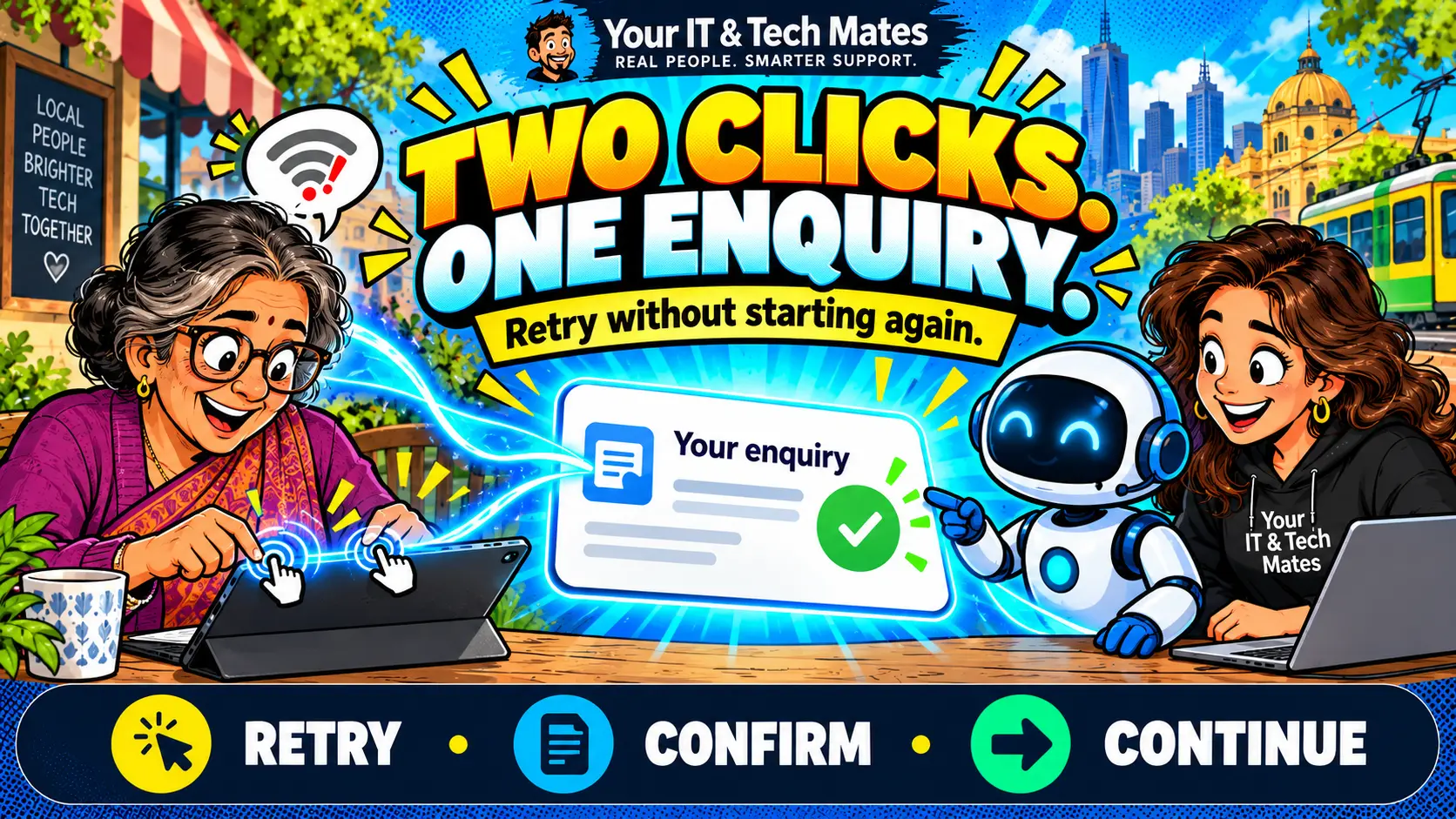
Quick answer
Our QuoteMe request pathway checks for an existing submission from the same enquiry session. A repeat submission for that session is designed to return the existing request instead of creating a second one. Check the saved reference and continue its conversation. This protection does not merge separate enquiries or prove that an email, attachment or staff response has completed.
What to do if Send seems to take too long
- Wait for the current step to finish and read any status message. A delay alone does not tell you whether the server saved the request.
- If a reference or saved-request link appears, open it and keep that conversation.
- If the interface says the step is unconfirmed and offers Retry, use that option within the same enquiry.
- If you are still unsure, contact the team with any existing reference rather than opening several new requests.
A missing email is not proof that the enquiry failed. The request record, attachment transfer and notification delivery are different parts of the workflow. Each needs its own honest status.
One slow send, one request
Illustrative workflow: a customer in Epping finishes a laptop enquiry and clicks Send. Their mobile connection stalls after the server has saved it, so they retry from the same session. The request gateway checks the submission identity and can return the existing reference instead of creating another request.
For the customer, the next step is to open that conversation. For staff, the aim is one request to review rather than several copies that need reconciliation. We have not published a measured reduction in duplicate handling time, and this example is not a report of a particular customer incident.
The ordinary engineering that makes an AI workflow dependable
The technical term is idempotency: repeating the same operation should not create another copy of its result. Our gateway derives a stable submission key from the QuoteMe session and checks for a saved request within the database transaction. Repeat attempts reuse the matching request when the ownership conditions pass.
Owner checks matter as much as duplicate checks. Recovery must not reveal another person’s reference or silently redirect an immutable retry to a different recipient. A new customer need, changed ownership or a different session is not something the system should casually merge into the old request.
AI can help prepare a useful summary, but it does not replace these application controls. We treat request creation, recovery and human review as explicit steps. This is part of building practical software around AI rather than relying on a fluent chat reply to establish that an action succeeded.
A saved request can still have a pending attachment
Request creation and file transfer are tracked separately. If the request exists but attachments are pending, the safer recovery path works with that same request. Resending the entire enquiry is not required just because one file still needs attention.
Likewise, a notification attempt does not establish that the customer read an email or that staff have reviewed the request. The screen should describe what is confirmed and what still needs checking. For customers, that means fewer ambiguous “all done” messages; for the team, it means a clearer place to investigate a problem.
What this protection does not promise
- It protects supported repeat submissions tied to the same session, and the newer same-owner reviewed-case pathway can converge supported drafts on the existing request. It does not automatically deduplicate unrelated requests across browsers, accounts or channels.
- It does not cancel or merge requests that a customer deliberately created separately.
- It does not guarantee message delivery, immediate staff review, appointment availability or repair completion.
- It does not approve a quote, take payment or authorise paid work. Those decisions have their own steps.
If you genuinely have another device or a separate problem, explain that clearly. If you only need to correct a detail on a sent request, continue the existing conversation.
Why small businesses should care about retries
Enquiry forms, appointment requests and customer portals all face uncertain connections. A practical automation project should consider the retry and recovery path as carefully as the first successful click. That is one of the lessons from our own QuoteMe development at Your IT & Tech Mates, based in Epping and Wollert.
Explore our approach to hardening a business AI system and human review in small-business AI decisions. If your staff regularly untangle duplicate enquiries, describe that process and the tools you already use so we can assess a focused improvement.
Two drafts can still belong to one reviewed enquiry
Our newer supported pathway also checks the same verified customer and reviewed enquiry case when more than one draft reaches submission. This can return the existing conversation instead of creating another request. It is not a promise to merge every enquiry across browsers, accounts or channels.
If the later draft contains changed wording or answers, the screen may say new details have not been sent. Those details remain in review. Open the existing conversation, check what is there and deliberately send the update. A safe retry must not silently discard a correction or pretend it reached the team.
An unchanged retry and a stale draft need different handling. Follow the offered retry for an uncertain step; use Refresh saved enquiry when the saved details changed. Neither action is approval of a quote, paid work or a booking.
See how to check repairs, quotes, invoices and device history in My Tech Help.
Frequently asked questions
Will clicking Send twice always create two enquiries?
The supported QuoteMe request pathway checks repeat submissions from the same session and is designed to return the existing request. It does not automatically merge requests from separate sessions or channels.
Does a missing confirmation email mean my request failed?
No. Check for the saved request reference or conversation. Request saving and notification delivery are separate, so contact the team if the status remains unclear.
Should I send a new enquiry to retry an attachment?
Use the existing saved request and any attachment retry option shown. A pending file does not necessarily mean the request itself was not saved.
Read the six-part QuoteMe in practice series
Follow the customer steps and the development decisions behind them.
- Is My QuoteMe Request Saved or Sent? How to Continue Safely
- iPhone Screen Repair Costs in Epping and Wollert: Guide Price or Final Quote?
- How to Send Repair Photos and Files Privately Through QuoteMe
- Can I Ask About Costs Without Starting My Enquiry Again?
- Slow Laptop and a Loud Fan? Tell Us Both—Without Technical Jargon
- How We Prevent Duplicate Enquiries When Someone Clicks Send Twice
Choose your next step
Need help with a device? Tell us what is happening in your own words. Already sent a request? Continue its conversation. Want a similar enquiry workflow for your business? Tell us which task and tools you want to improve.
Review your details before sending. Preparing an enquiry does not book a service, accept a quote or approve paid work. The team confirms scope, price and arrangements.
Based in Epping and Wollert, helping across Melbourne’s north. Check service areas or message our team.