
From Problem to QuoteMe: How a Customer Issue Becomes a Reviewed Tech Help Request
The useful handover is not a bigger form. It is a smaller, clearer summary of what the customer saw, what they already tried, what remains uncertain and what needs human review.
Quick answer
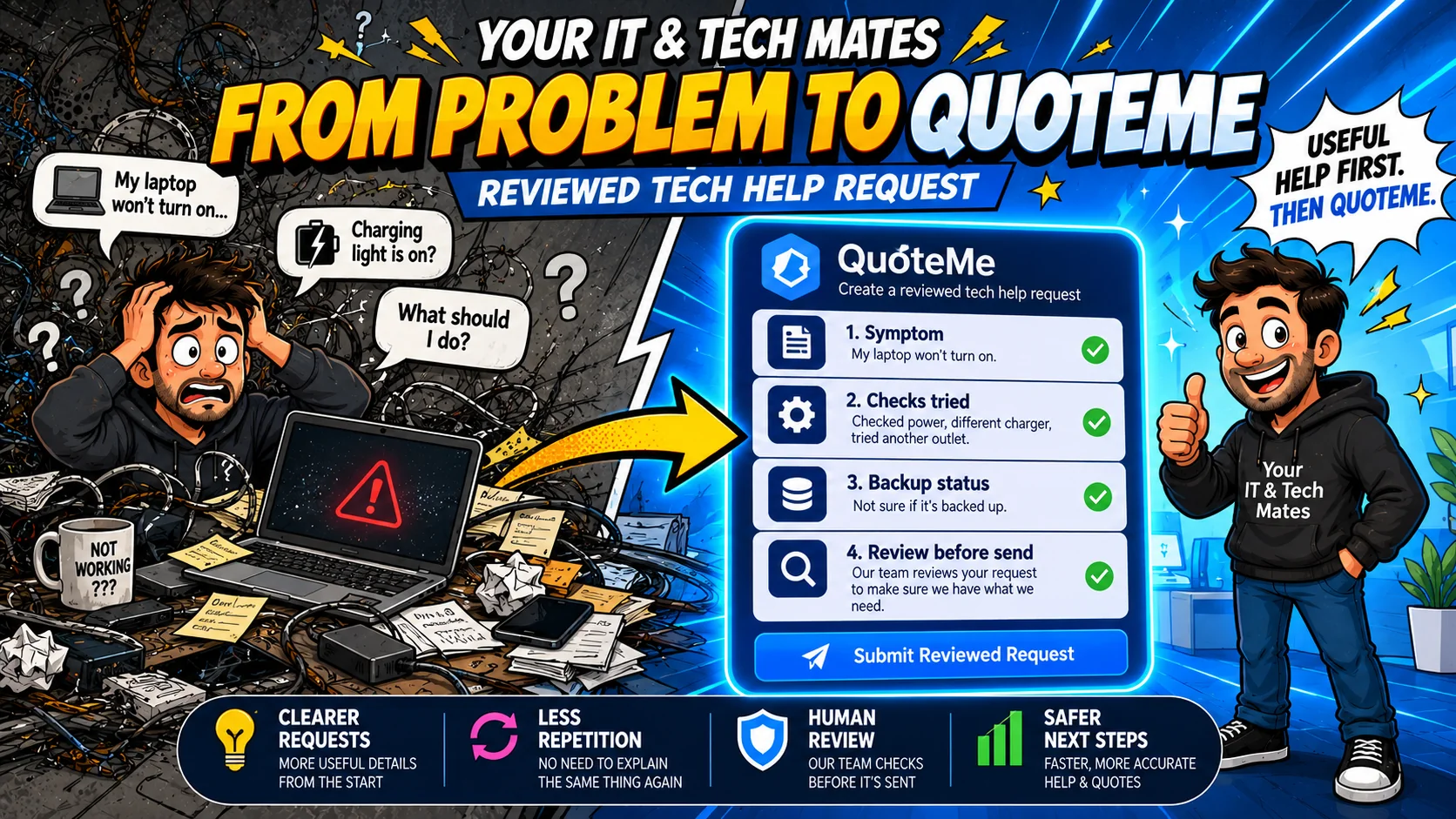
A good QuoteMe handover preserves the customer’s own problem, adds only useful confirmed context, and clearly separates what is known from what still needs checking. The customer gets help first, then chooses whether to continue the same context into a reviewed request.
Why “tell us everything” is a poor starting point
When a laptop will not start, a customer rarely knows whether the cause is a charger, battery, screen, storage problem or something on the main board. A form that immediately asks for a service category can force the customer to guess before the business has understood the symptom.
We prefer to begin with observable facts: what happens when the power button is pressed, whether there are lights or fan activity, whether an error appears, what safe checks were already tried, and whether important files are backed up.
The first job is to make the problem clearer
The website can turn a vague message such as “my laptop is dead” into a more useful description without pretending it has made a final diagnosis. For example, “charging light is on, but pressing power does nothing” is far more actionable than choosing “battery replacement” from a menu.
The wording matters. A charging light confirms some power activity, but it does not prove which component has failed. That uncertainty belongs in the result, not hidden behind a confident label.
What we carry forward into QuoteMe
A useful continuation can include four small groups of information:
- Symptom: what the customer actually sees or hears.
- Checks tried: safe external checks already completed.
- Safety and data context: warning signs and whether important files are backed up.
- Open questions: anything that still needs a person or device-specific assessment.
This reduces repetition without turning the website into an autonomous repair system.
Why review before send matters
Carrying context forward should not mean silently submitting a request. The customer should still see what is being carried into QuoteMe, change details if needed and choose whether to send it. The same boundary applies after submission: a request is not a confirmed booking, final diagnosis or authority for paid work.
A practical laptop example
Suppose the customer selects “lights or fan come on, but the screen stays black”, confirms there is no swelling or burning smell, says they disconnected USB devices, and is unsure whether files are backed up. The useful result is not “screen replacement required”.
A safer summary is: the laptop is showing power activity but no usable picture; this could involve the display or startup hardware; accessories have already been disconnected; backup status is unknown; avoid destructive reset or reinstall steps until the data risk is understood.
The handover should save typing, not remove judgement
Automation is useful when it moves confirmed information to the next step. It becomes risky when it converts uncertainty into a promise. Pricing, routing, service scope, payment and submission rules should remain owned by the systems designed for them.
That is the design principle behind the handover: preserve context, reduce repeated explanation, and keep the important decision points visible.
What small businesses can take from this
The same pattern works outside IT support. Start with the customer’s observable problem, ask only the questions that change the next step, return something useful before asking for contact details, and carry confirmed answers into the next workflow. The result can feel much more helpful without giving AI control over commercial commitments.
Frequently asked questions
Does QuoteMe automatically diagnose the problem?
No. The guided information can make the symptom clearer, but diagnosis may still require model-specific checks or hands-on assessment.
Does continuing in QuoteMe submit the request automatically?
No. The customer should review the carried-forward details and choose whether to send the request.
Can the handover include backup status?
Yes. Backup status is useful context because it can change whether destructive troubleshooting should be avoided.
Related reading
Need tech help now?
Start with the problem in your own words. QuoteMe can carry useful context forward, and you can review the request before sending it.
Follow Building QuoteMe in Public
Continue through the ten-part founder series, from the customer’s first question to clearer conversations, controlled tools and human-reviewed requests.