Matches the words
A keyword search may mainly match “email” and return a general email-support page.
It can still be useful for direct navigation, but the customer normally has to choose the right wording, page or category themselves.
Example for this industry
Custom intent-aware software for IT support and managed service businesses that interprets customer issues, identifies urgency and routes requests to the right support workflow.
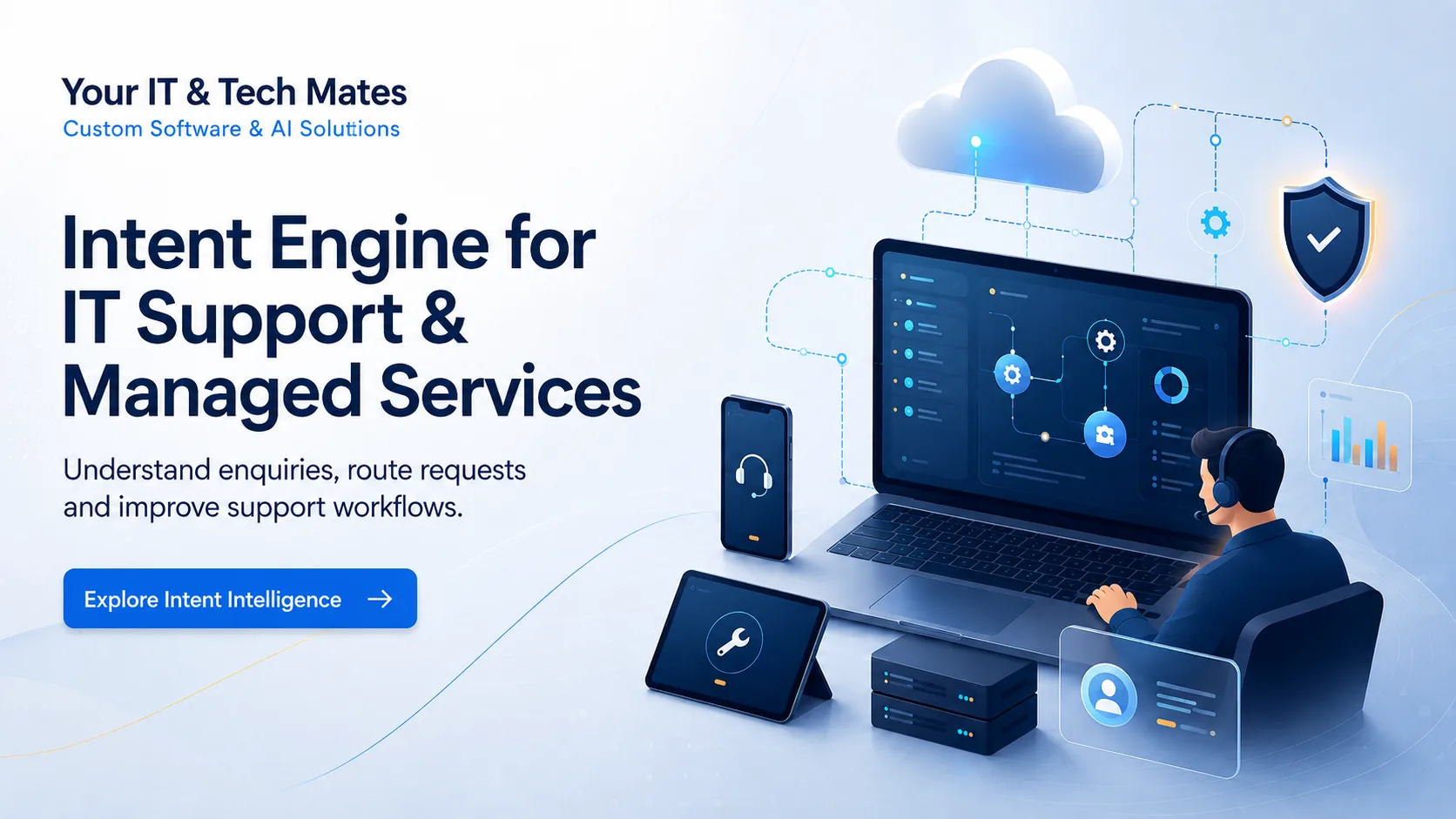
IT support requests rarely arrive in neat technical language. Customers describe symptoms, devices, urgency and business impact in their own words, leaving staff to interpret and triage every message.
“Our email is down for three staff, Microsoft 365 keeps asking us to sign in, and we have a client meeting in an hour.”
An intent-aware system can turn that message into structured context before the next step happens.
IT support teams rarely receive perfectly structured tickets. A user might mention a symptom, a device, a deadline and the effect on their work in one message, while leaving out the technical details a service desk normally needs. The first job is therefore not fixing the issue — it is understanding what the person is actually asking for.
An intent-aware layer can sit in front of a help desk, form or shared inbox and convert everyday language into structured support context. It can recognise likely issue type, urgency, affected users and business impact, then decide whether to ask a follow-up question, create a ticket, surface self-help or escalate to a technician.
Traditional website search is useful when a customer already knows the exact words your business uses. Intent search is designed for the messier reality: people describe a problem, goal or situation in their own language and often include several needs in one message.
“Our email is down for three staff and we have a client meeting in an hour.”
A keyword search may mainly match “email” and return a general email-support page.
It can still be useful for direct navigation, but the customer normally has to choose the right wording, page or category themselves.
Intent search can recognise an IT incident, multiple affected users, Microsoft 365 context, business impact and urgency—even though the customer never uses technical support terminology.
The result can therefore be more than a page match: it can become a qualified enquiry, guided next step, workflow trigger or deliberate human handoff.
The value of intent search is different in every industry. For this type of business, the strongest advantages are:
Customers can describe what is happening instead of knowing the technical name of the fault.
Business impact such as multiple users being affected or an imminent meeting can influence routing.
Device, account, platform and impact details can be structured before a technician receives the request.
Requests can move to the appropriate queue rather than relying on the customer choosing the correct support category.
Repeated enquiry patterns can reveal recurring issues, training gaps or services clients need more often.
One useful test of an intent system is whether it can deal with the variety of language real customers use, not just one perfect demo question.
“I changed phones and now I cannot get into Microsoft 365.”
Recognise account-access intent, likely MFA context and the need for identity-safe handling.
“My laptop turns on but the screen stays black and I have a meeting in 30 minutes.”
Capture device, symptom and urgency before technician handoff.
“Three staff cannot send email but everyone else can.”
Separate a multi-user incident from an individual support request.
“We have a new employee starting Monday and need everything ready.”
Route to onboarding rather than break/fix support and collect the required setup details.
High-risk, uncertain, safety-sensitive or business-critical decisions should remain subject to appropriate human review.
A practical outcome of converting unstructured enquiries into a clearer, controlled workflow.
A practical outcome of converting unstructured enquiries into a clearer, controlled workflow.
A practical outcome of converting unstructured enquiries into a clearer, controlled workflow.
A practical outcome of converting unstructured enquiries into a clearer, controlled workflow.
The value is not simply producing an AI answer. It is reducing the friction between an unstructured enquiry and the next useful business action.
The Intent Engine does not need to become another isolated tool. A commercial build can be designed around the systems your team already uses, subject to the integrations and security controls those systems support.
Credential resets, security incidents, access changes and uncertain technical diagnosis should follow your organisation’s security and approval controls. The Intent Engine can prepare and route the request without bypassing those controls.
Commercial fit for IT Support & Managed Services
Website enquiries, forms, shared inboxes, portals or other approved customer and staff intake points.
Intent, context, timing, urgency and the industry-specific details already demonstrated on this page.
Routing, clarification, structured hand-off, notification or a controlled action in an existing business system.
We map your real request types, terminology, confidence checks, escalation points and integrations before deciding what should be automated.
No. It can sit in front of or alongside an existing help desk to improve intake, classification and routing.
That is one of the main use cases. Customers can describe symptoms in ordinary language while the workflow extracts the context your team needs.
Some low-risk workflows may be automated, but access, security and uncertain technical issues should remain subject to appropriate controls and technician review.
Yes. A custom implementation can use your service catalogue, priority rules, escalation paths and support hours.