Can AI Diagnose Computer Problems Online? What It Can and Can’t, Do
AI can narrow the problem and improve the handover. It should not pretend that software-only evidence can replace every physical test or technician diagnosis.
Quick answer
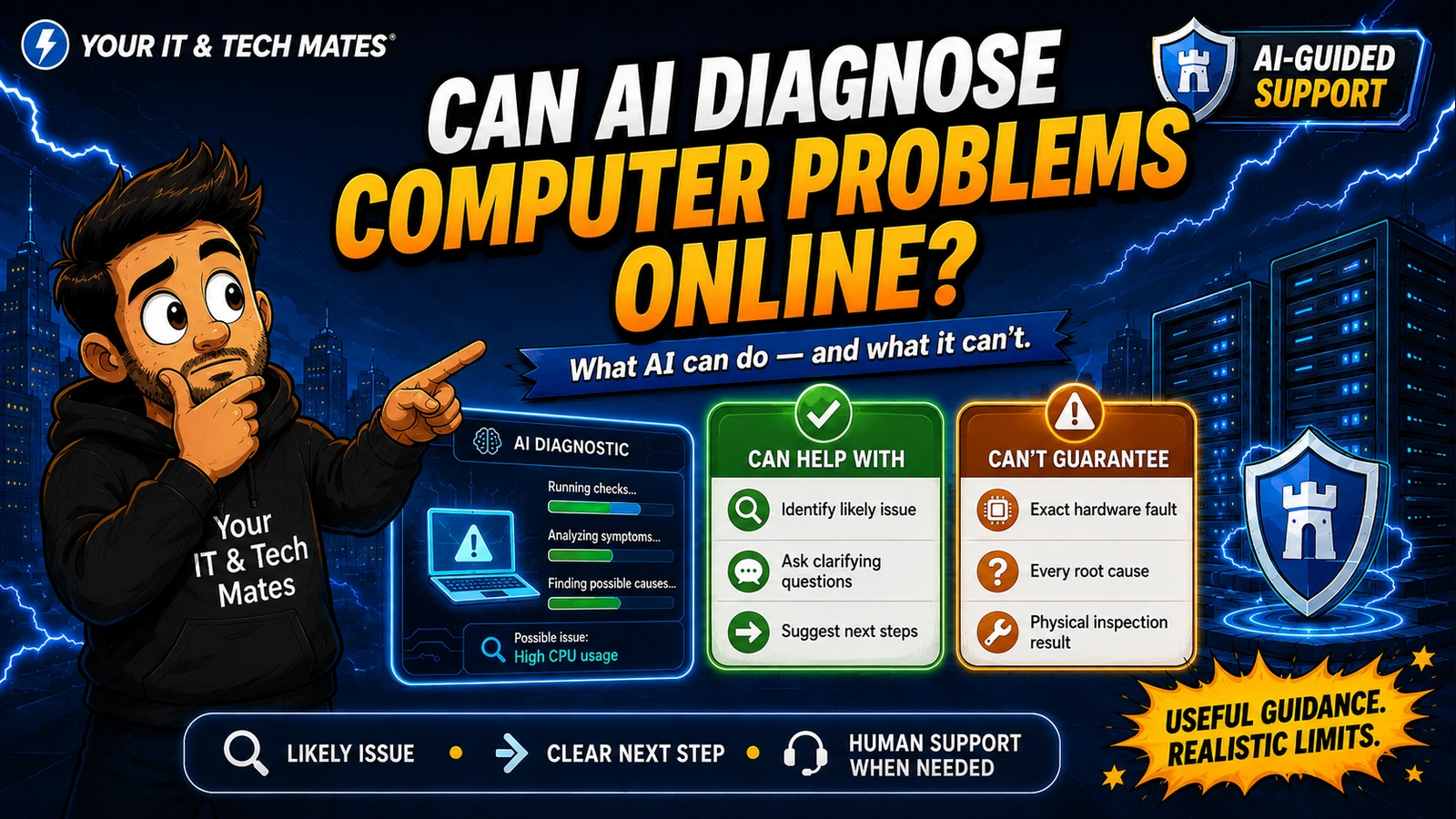
AI can help identify likely computer problem areas, ask clarifying questions and suggest safe next steps but it cannot guarantee every root cause without proper testing.
What AI can do well
AI-assisted support can organise symptoms, identify likely help areas, ask clarifying questions, explain safe checks and recommend the most appropriate next support step.
What AI cannot see
A browser cannot physically inspect a loose connector, measure a battery, test a power rail, hear a failing bearing accurately or verify every intermittent hardware fault.
Likely cause is not confirmed cause
A pattern may strongly suggest memory pressure, a network issue or storage failure, but a responsible tool should describe that as a likelihood until the necessary evidence confirms it.
Screenshots and device details can improve context
An error message, visible settings or device model can reduce ambiguity, but each should be treated as evidence rather than automatic proof of a diagnosis.
Safety should override convenience
If the description suggests battery swelling, smoke, electrical damage, active account compromise or another high-risk condition, ordinary troubleshooting should stop and safer instructions should take priority.
The goal is a better next step
The most useful outcome is often not “AI solved it”. It is “we now know what to try safely, what not to do and which type of support is appropriate”.
A realistic example: a laptop that suddenly will not charge
A customer reports that a laptop battery is at 8% and will not charge. Online guidance can ask whether the charger light is on, whether another compatible outlet works, whether there is visible cable damage and whether Windows shows “plugged in.” That can narrow the possibilities. It still cannot physically test the charger, charging port, battery health or motherboard power circuit from a webpage.
Online narrowing versus confirmed diagnosis
- Online support can: Organise symptoms, identify likely categories, suggest low-risk checks and decide whether hands-on service is sensible.
- Online support cannot: Measure voltage, inspect internal damage, verify intermittent hardware faults or guarantee a root cause without evidence.
- Customer benefit: You can avoid unnecessary steps while still understanding when a physical inspection is the efficient option.
“Likely cause” can still be valuable
Customers often do not need absolute certainty before taking the next step. Knowing that the fault is more likely device-specific than network-wide, or that a hardware check is now more useful than another software reset, can save substantial time.
The safest online diagnosis is sometimes a decision, not a label
A responsible tool may conclude: “We cannot confirm the cause remotely, but the evidence suggests further DIY steps are unlikely to help. Back up what you can and arrange a technician.” That is a successful outcome, not a failure of AI.
Frequently asked questions
Can AI diagnose hardware failures accurately?
It can identify patterns that suggest hardware faults, but many hardware diagnoses still require physical inspection or testing.
Can a screenshot prove the cause of a problem?
Usually no. A screenshot can provide useful evidence such as an error code or visible setting, but it rarely proves the complete root cause.
When should I stop troubleshooting online?
Stop when there is a safety concern, the steps could risk data or equipment, or the problem requires physical testing or specialist access.
How this connects to our Guided Tools
Our Guided Tools are designed to let customers describe a problem naturally, answer a small number of relevant questions, review what the system understands and then choose the next step. Quick-choice tools remain available as a fallback, and QuoteMe stays customer-controlled.
Need help with a real tech problem?
Tell us what is happening in plain English. We will help you work out the most useful next step without expecting you to diagnose it first.