How Our Website Understands Customer Problems Written in Everyday English
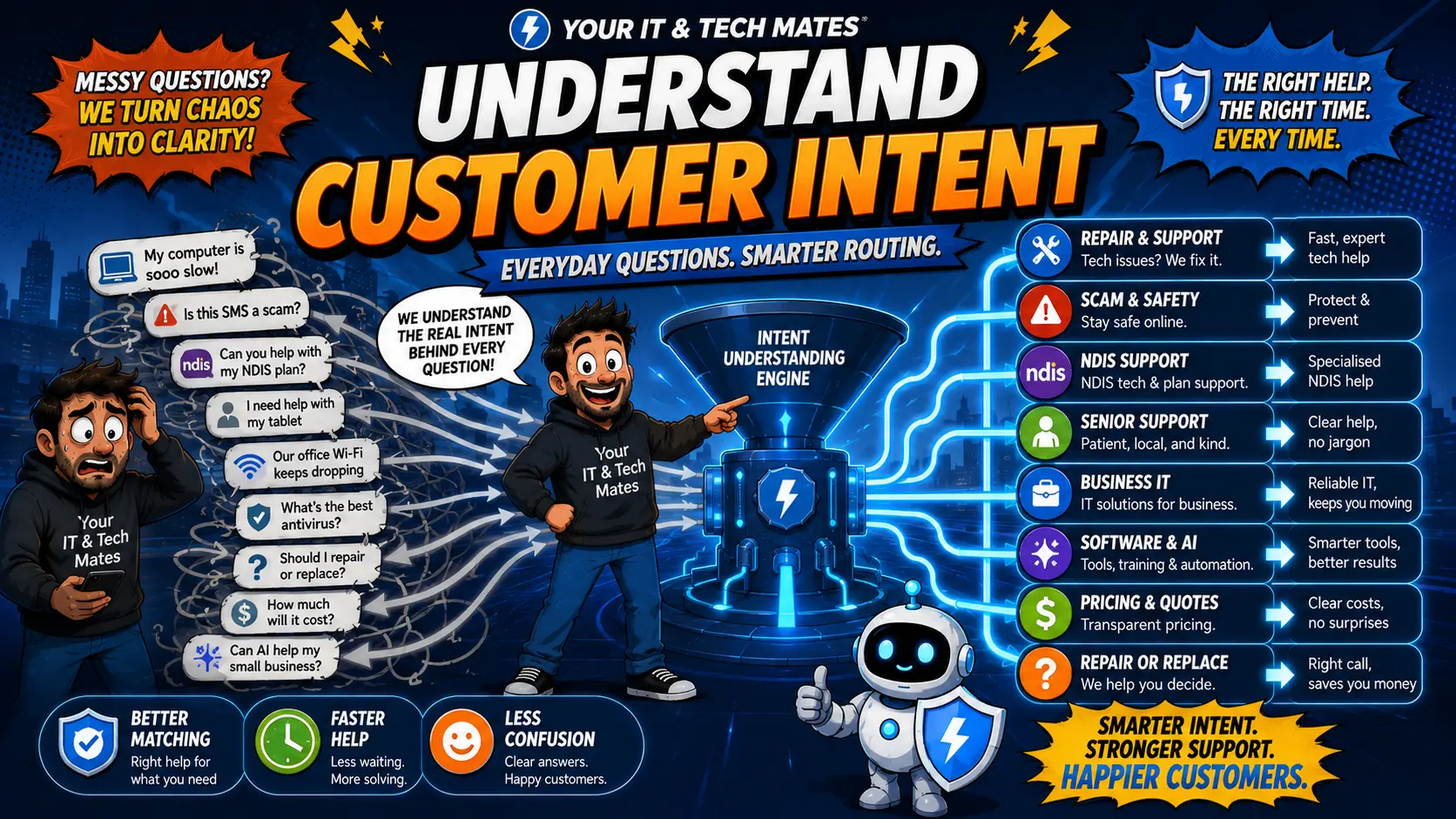
Customers describe the problem in normal words. The website matches that description to a reviewed help area before showing information, tools or QuoteMe.
Quick answer
Customers describe the problem in normal words. The website matches that description to a reviewed help area before showing information, tools or QuoteMe.
The practical problem
People usually say things like “my laptop is slow”, “this text looks suspicious” or “Wi-Fi drops out in the back room”. They should not have to know our technical service labels before the website can help.
What we built
We created a small set of reviewed help areas connected to the real website pages, tools and customer actions. The match is only a guide to the next step; it is not a diagnosis.
How the workflow works
- The customer types a short problem description.
- The website checks the input before smarter processing begins.
- The wording is matched to the most suitable reviewed help area.
- That help area narrows which business information should be considered.
- If the match is weak, the website can show broader guidance instead of pretending it is certain.
Where AI is useful
AI can help understand informal or unclear wording when simple rules are not enough, but the result still has to fit one of the reviewed help areas owned by the website.
Where AI is not allowed to decide
A help-area match is not a repair diagnosis, booking, NDIS decision or price. It also cannot create a new public page for every different way a customer asks the same thing.
Security, privacy and cost controls
Customer input is limited and checked, and browser fields cannot choose the outside AI service or spending rules. Unknown or unsafe wording can fall back to broader help instead of creating a false business fact.
What another small business can take from this
Build around the words customers naturally use, then connect those words to a small set of business-owned help areas. This can improve search, forms and support even without generative AI.
What this does not prove
The website can misunderstand a very short or unusual description. The goal is to improve the next step, not replace a person’s diagnosis or service scoping.
Part of our smarter website project
This implementation story is one part of a larger Your IT and Tech Mates project exploring how practical AI, automation, trusted business knowledge and human-controlled workflows can work together.
Frequently asked questions
Do I need to know the technical name of my problem?
No. You can describe what you are seeing in everyday words.
Is the matched help area a diagnosis?
No. It only guides the website toward more relevant information and next steps.
What if the website is not sure?
It can show broader guidance or another support path instead of pretending the match is certain.
Does every wording create a new page?
No. Different ways of describing the same problem are matched to existing reviewed help areas.
Can this work without generative AI?
Yes. Clear categories and normal website rules can handle many common questions; AI is only an extra tool when useful.
Related Your IT and Tech Mates help
Could a similar workflow help your business?
Tell us how the process works today. We can look at whether better website logic, automation, custom software, AI—or something simpler—would be useful. A person reviews the request before any scope or price is agreed.