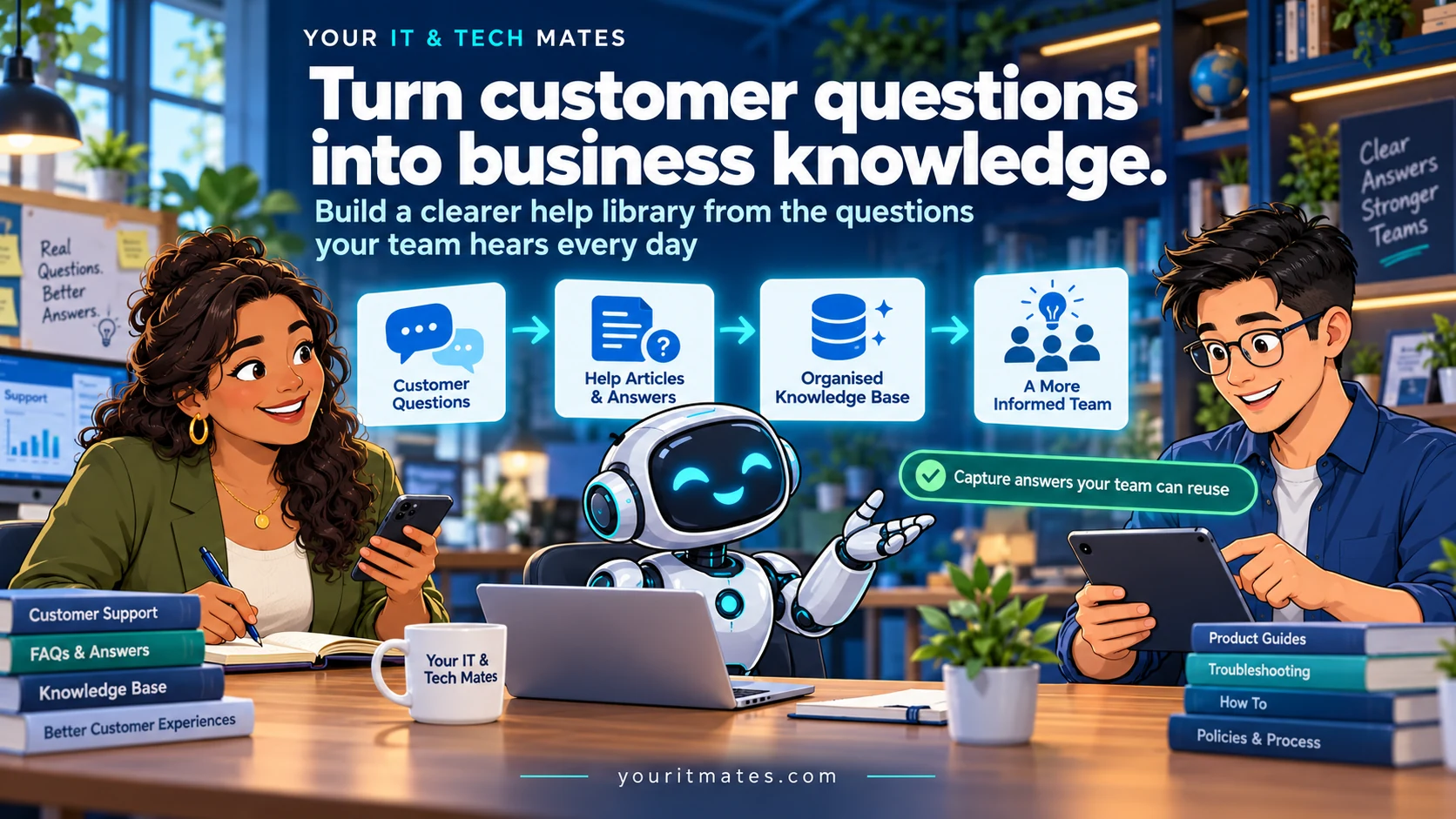
The practical problem
Customer questions are valuable clues to unclear information, but a single conversation is not permission to publish private details or assume that everybody has the same problem.
A human-reviewed workflow
Group recurring public questions, review the answers with a knowledgeable staff member, link each answer to the appropriate existing service or guide, and give it an owner and review date. Keep sensitive enquiries outside public publishing prompts.
What we have built — and what we have not proved
Our editorial approach treats public article discovery separately from the approved knowledge used by our Virtual Receptionist. A discoverable article alone does not authorise automated customer advice.
How this could help another small business
For another business, an FAQ library might reduce uncertainty and help new staff locate approved answers. Any measurable results would need actual testing; they are not promised here.
When to ask for help
If your business has a similar challenge, begin with a practical workflow review. Visit small-business software and AI services or describe your need through QuoteMe. The existing Virtual Receptionist may assist with approved guidance where available; confirm the live entry route and knowledge before adding a dedicated link. Staff assess scope, privacy-sensitive issues and any formal quote or appointment.
Related reading
Common question: Can customer conversations automatically become website articles?
No. Topics can inform proposals, but customer privacy, factual review and publication approval come first.
What turns a collection of answers into knowledge
A useful knowledge base needs more than a chatbot. Each answer should have a clear subject, an authorised source, a responsible reviewer and a path to related help. Our editorial work separates discoverable pages from approved Virtual Receptionist answers: finding an article is not the same as authorising automated advice from it.
How customer questions can inform improvements safely
Repeated questions, corrections and unclear wording can suggest that a guide needs work. The team should look for aggregate patterns, remove identifying details and check whether the issue is already answered. Staff can then prepare a plain-English explanation and confirm it against the service catalogue. Private customer messages must not be copied into a public FAQ.
Illustrative example: a local repair business
Suppose customers frequently ask what information is needed before receiving a repair estimate. A reviewed guide could explain the type of device information to prepare, how to describe symptoms and what an estimate does not confirm. The guide can point to a supported enquiry route, while a technician remains responsible for assessing the actual issue and final price.
A practical knowledge-maintenance routine
Start with one category of questions. Create a short answer template covering the question, safe general guidance, when to seek help, owner and review date. Link relevant pages; check for contradictions; record what changed. Review the answers when a service, policy or tool changes rather than assuming they stay correct.
What AI should not do
AI should not treat every visitor message as permission to publish it, provide unsupported diagnoses or claim a confirmed booking. If a question falls outside approved knowledge, the safe response is clarification or human escalation.
Need help with this problem?
Describe the business workflow in your own words. The existing team reviews scope and confirms quotes, appointments and commitments. Never share passwords or sensitive customer information in public enquiries.