
What this means for you
This helps you understand how to build real proof, stay within safe task boundaries, and use the right student pathway before anything is shared publicly.
Why student pathways need care
A student might be confident with setup, basic troubleshooting, communication or helping someone understand a device. That does not mean they should handle private data recovery, business systems, account access, scam recovery or complex repairs alone.
The network should help students build real proof in stages. The safest pathway starts with simple, supervised, low-risk work.
What providers can mentor
Providers can help students learn how to ask the right questions, explain a problem clearly, write a safe job summary, protect customer privacy, recognise risk, and know when to escalate.
These skills are valuable because tech support is not only technical. It is also about calm communication, careful boundaries and respecting customer trust.
Proof should be realistic
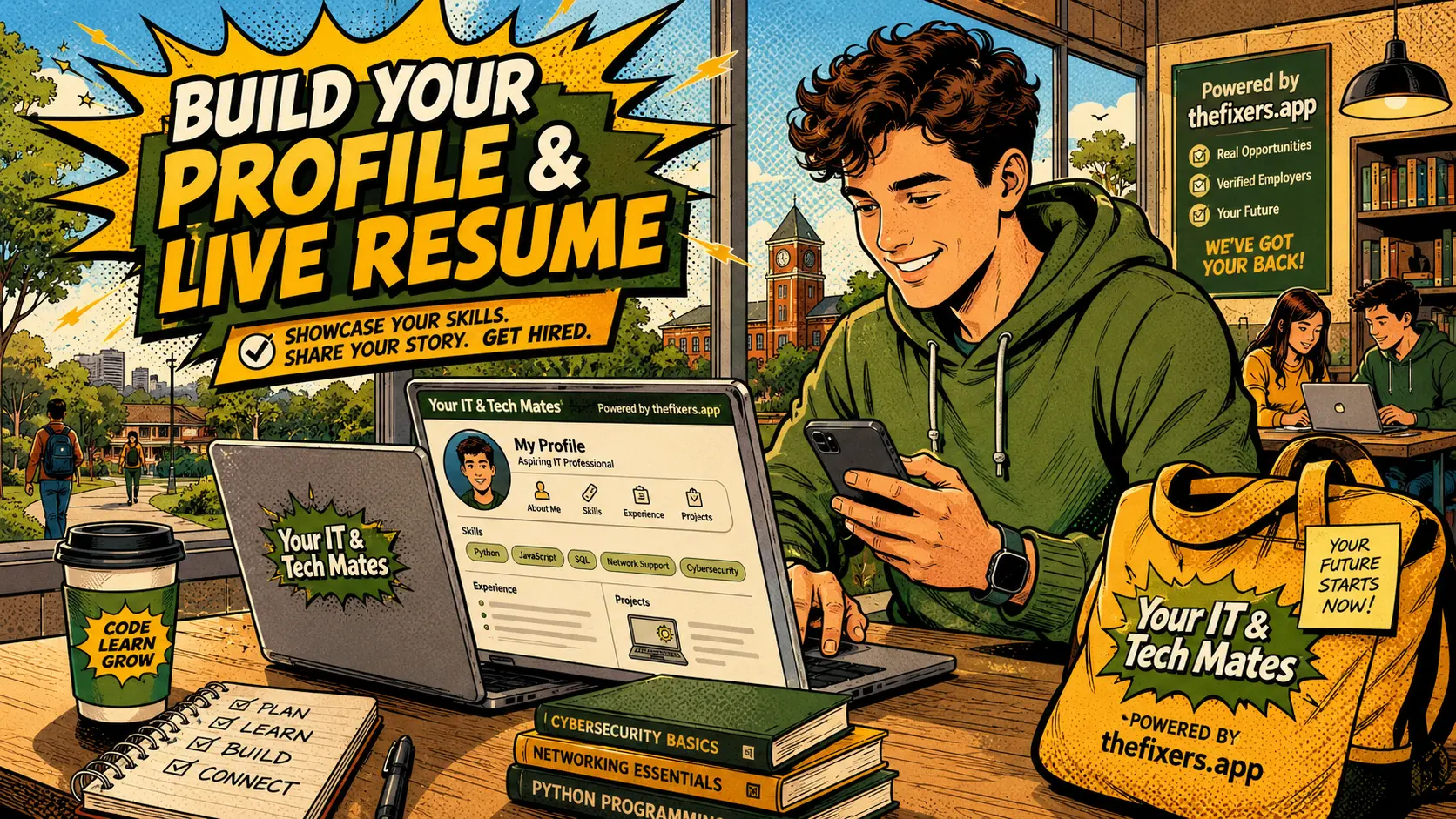
A student Live Resume is strongest when it shows real, appropriate experience. A proof card might describe helping with device setup, writing a plain-English troubleshooting summary, completing a campus mission, or assisting with a safe support task under review.
It should not exaggerate. It should not publish private customer details. It should not make the student look approved for work they are not ready to do.
Mentoring is not free labour
A good student pathway is not about using students cheaply. It is about building supervised experience, confidence and employability. Providers who mentor should help create safe learning moments, not push students into uncomfortable work.
The strongest providers protect both the customer and the learner.
When a student should escalate
Students should escalate when a job involves passwords, payment accounts, suspected scams, business data, private documents, medical or NDIS context, major data loss, hardware risk or anything that feels beyond their role.
Escalation is not failure. It is part of good support.
Final customer check: does this page help the reader?
A good network article should not make the reader decode product language. It should quickly answer: what is this, why does it matter, and what should I do next? For this topic, the practical benefits are:
- You can understand how opportunities are reviewed before they reach you.
- You can keep availability, profile information and customer handover expectations clearer.
- You are not placed into an automatic dispatch marketplace.
- You can support local customers and student pathways without losing control of your work boundaries.
The page should feel useful even if the reader does not click a button straight away. They should leave with a clearer understanding of the pathway, the safety limits, and the next action that suits their situation.
What providers should not have to guess
Providers should not have to guess whether a request is suitable, whether a customer has enough information, or whether an opportunity has been reviewed. The network should make the pathway clearer before a provider commits time.
It is also important that provider content does not sound like automatic dispatch. The benefit is reviewed opportunity, clearer availability, better handover and a more trusted local network.
How this helps a provider decide whether the network fits
Providers do not need another noisy lead marketplace. They need enough context to decide whether a local opportunity, referral, mentoring pathway or profile update is worth their time. This article should make that value clear. The network is built around reviewed opportunities, safer customer handover and visible trust signals, not automatic dispatch.
A provider should be able to understand how their availability, profile, proof, reviews and referrals fit together. If they cannot take a job, referring it properly is better than leaving the customer stuck. If they can support a student pathway, the mentoring boundary should be clear. If they want more work, their profile needs to show what they do, where they help and what kind of jobs are suitable.
What the provider should feel after reading
A strong provider article should leave the reader thinking, “I know how to start, I know how my information is protected, and I know this is a reviewed pathway rather than a free-for-all.” That is the benefit of the content. It builds trust before a provider applies, updates availability, refers a job or mentors a student.
The article should also protect expectations. It should not promise instant work, guaranteed leads or automatic customer assignment. It should explain the pathway honestly: apply, build a profile, keep details current, accept suitable work, and support the network where the fit is right.
User feedback pass: make the page easier to act on
The final customer check for this page is simple: a reader should not have to understand the whole platform before they can decide what to do. The article should give enough context, then point to the right next step without pressure. That means the copy needs to answer the practical questions people usually have: Is this for me? Is it safe? What will I need to provide? What happens after I click? Can I stop if it is not the right fit?
The answer should be visible in the page itself, not hidden in a form or dashboard. A customer may be worried about a scam, a student may be trying to build confidence, a provider may be deciding whether the network is worth joining, and a partner may be checking whether a QR referral is safe to promote. Each reader needs a slightly different reassurance, but the same principle applies: clear steps, plain words, and no surprise exposure of private information.
This is also why the article keeps the main call-to-action buttons separate. A reader who wants a price guide should not be forced into the same pathway as a reader checking an existing request. A student building a profile should not be sent to the same place as a provider applying for work. A partner should not be asked to manage customer support manually when a safer referral path exists. The article should help each person choose the correct door.
From a user perspective, the best outcome is confidence. The reader should feel that Your IT & Tech Mates has thought about the messy parts of real-world tech help: family access, student learning, provider suitability, public proof, referrals, privacy and review. They should see that the network is not just a collection of pages. It is a safer way to move from a problem or opportunity to the next practical step.
Final publishing note for customer clarity
Before this page goes live, read it once as the person it is meant to help. The language should feel direct, useful and calm. The reader should not feel blamed for not knowing the system, and they should not feel pushed into the wrong action. The page should make the next step obvious while still giving them space to decide.
That is the difference between thin content and useful content. Thin content repeats a feature name. Useful content explains the benefit, the safe limit, the real-life situation and the next step. This page is written to do that, so the article can support Google indexing, AI summaries and real customer confidence at the same time.
The clearest next step
Start with the provider application and profile pathway before expecting customer opportunities or mentoring links. A good next step should feel low-pressure. The reader should understand what happens next, what details are needed, and when a real person reviews the request before anything sensitive is shared or approved.
Related reading and network pathways
- Network
- How Providers Join Local Tech Help Network
- Secure Provider Availability Tech Help
- Refer Tech Jobs You Cannot Take
- Provider Profiles Reviews Proof Local Trust
Safety and privacy
Private details, job notes, proof, profile information and referral details should only be shown where they are useful and safe. The public article explains the pathway, while sensitive customer, student, provider or partner information stays inside the proper reviewed process.
FAQ
Can students do real tech work?
Yes, but only within suitable limits. Safe student tasks should match their skill level and be reviewed where needed.
What can providers teach students?
Providers can teach communication, safe troubleshooting, privacy habits, escalation signals and practical support steps.
Should students handle passwords?
No. Students should not collect, store or manage passwords. Sensitive access should be handled carefully by appropriate people.
Can student proof be public?
Only approved proof should be public. Student proof should avoid private customer details.
Why involve providers in student pathways?
Providers bring practical experience and can help students learn the real-world habits that make tech support safer and more useful.