
Microsoft 365 Account Warning Signs Small Businesses Should Not Ignore
A Microsoft 365 account issue may show up as strange login prompts, missing emails, new rules or messages staff did not send.
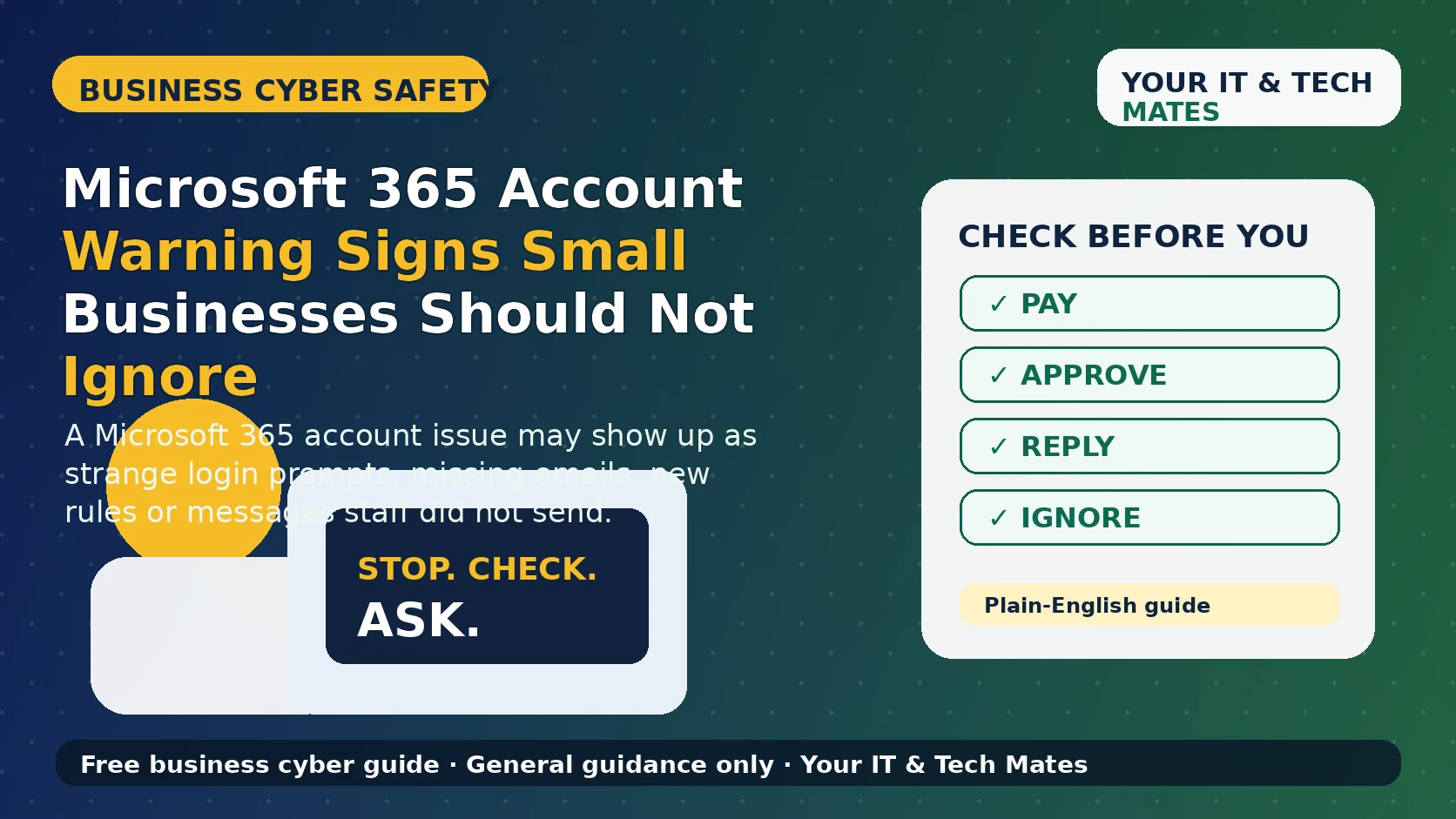
Quick answer: stop and verify using a trusted contact method before you pay, approve, reply or ignore warning signs.
Quick answer
If a business email account may be compromised, secure the account from a trusted device, review sign-ins and forwarding rules, protect it with MFA, and independently warn affected staff, customers or suppliers where needed.
Fast decision
What this means for a small business
A Microsoft 365 account issue may show up as strange login prompts, missing emails, new rules or messages staff did not send.
Most business cyber problems become expensive when a normal-looking request is handled too quickly. A safer process gives staff permission to pause, check the source, and ask for help before money, access or sensitive information is exposed.
This guide uses fake examples only. It is designed to help you prepare a safer next step, not to collect private records or replace professional investigation.
Warning signs to check
- Unexpected MFA or two-step login prompts.
- Emails sent, moved or deleted without the user recognising them.
- New forwarding rules, inbox rules or mailbox delegates.
- Unfamiliar sign-ins, unusual locations or password reset alerts.
What to do now
- Use the account safety check to collect warning signs without sharing passwords.
- Ask someone with the right admin access to review sign-ins and mailbox rules.
- Protect admin accounts with strong two-step login.
- Remove old staff accounts and unnecessary access.
What not to do
- Do not approve unexpected login prompts.
- Do not assume the issue is fixed just because the password was changed.
- Do not share login codes with anyone, including someone claiming to be support.
Related Business Cyber Safety links
Business email compromise
Continue with the related Business Cyber Safety guide.
What to do if business email is hacked
Continue with the related Business Cyber Safety guide.
Scam Safety hub
Use this when the issue looks like a scam message, fake invoice or payment redirection attempt.
Essential Eight small business hub
Review broader basics like two-step login, backups, updates, admin access and safer devices.
Benefits and practical outcomes
Use these outcomes as a practical check on whether the advice is making the situation clearer and easier to manage.
Reduce avoidable exposure
Simple account, update, access and verification controls can reduce common preventable weaknesses.
Recover with less guesswork
Documented owners, backups and evidence make incident response and restoration easier to organise.
Give staff a repeatable check
Plain-English steps are easier to follow than relying on memory when an unusual request arrives.
Prioritise the next fix
A short checklist helps separate urgent controls from improvements that can be scheduled later.
Example: an email account triggers an unusual sign-in
A staff member receives an unexpected sign-in alert. The business uses a trusted device to review recent sign-ins, changes the password where needed, checks MFA and recovery methods, and reviews forwarding rules.
Outcome: the account is checked systematically instead of relying on the suspicious email thread.
FAQ
Is this a formal cyber audit?
No. This is a practical self-check guide, not a formal audit, investigation, certification or guarantee.
Should I share passwords or login codes?
No. Do not share passwords, login codes, banking passwords, card numbers or private customer records through this guide.
What if money has already been sent?
Contact your bank immediately. Then collect the invoice, email details and verification notes for review.